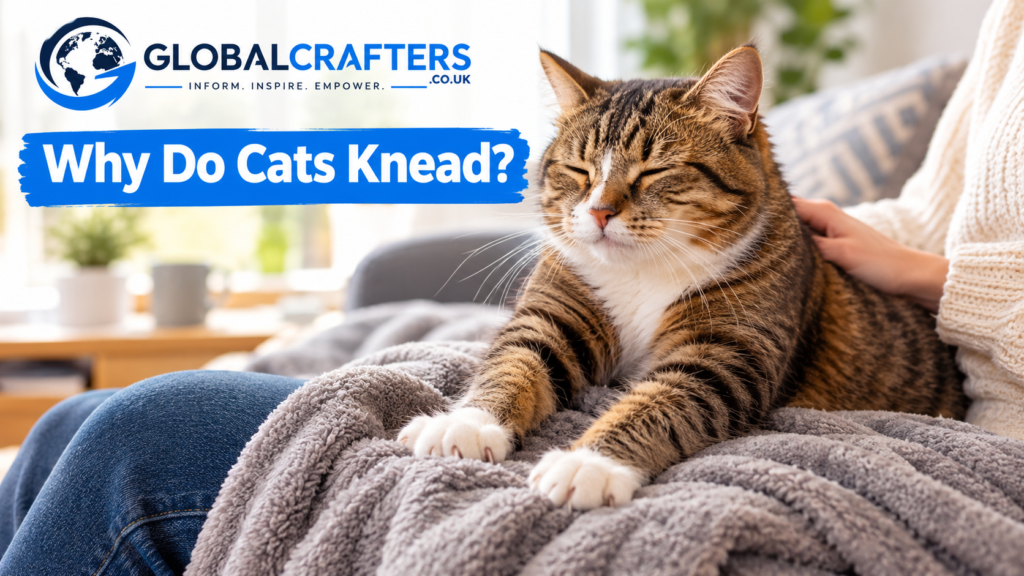

Cat kneading is the repeated movement of the front paws against a soft surface. A cat may press one paw down, then the other, creating a rhythmic motion that looks similar to kneading dough. Some cats extend their claws during the movement, while others keep their claws mostly retracted.
Kneading is generally considered a normal feline behavior. It can occur when a cat is relaxed, comfortable, sleepy, affectionate, or interacting with a familiar person or object. Although the behavior can sometimes be connected with other emotional states, kneading by itself is usually not a sign that something is wrong.
Why Do Cats Knead?
One of the main reasons cats knead is because the behavior begins very early in life. Kittens instinctively knead their mother’s abdomen while nursing. The movement is associated with feeding and early comfort, so the behavior can remain meaningful even after a kitten becomes an adult cat.
Adult cats may therefore knead when they experience feelings of security and relaxation. A comfortable blanket, a favorite sleeping area, or a trusted person can create a situation that reminds the cat of the safety it experienced during kittenhood. This does not mean an adult cat believes it is nursing. Instead, the behavior may have become part of its natural comfort routine.
Kneading can also serve several other purposes. Cats have scent glands in their paws, so pressing their paws against a surface can contribute to scent marking. The movement may also help them prepare a comfortable resting place.
For most cats, kneading is not associated with just one explanation. A cat can knead because it feels relaxed, because it likes the texture of a particular surface, because it is preparing to rest, or because the behavior has become a familiar way to express comfort.
Why Do Kittens Knead Their Mothers?
Kneading begins during kittenhood and is closely associated with nursing. Young kittens press their paws against their mother while feeding. The rhythmic movement is a natural part of early development and occurs when kittens are completely dependent on their mother for food, warmth, and protection.
This early experience may help explain why adult cats often knead when they are especially comfortable. Soft blankets, warm beds, and human laps can provide sensory conditions that encourage the same behavior. The adult cat is not necessarily thinking about its mother in a human sense, but the behavior can remain connected to feelings of comfort and security.
The connection between nursing and kneading is one of the most widely recognized explanations for the behavior. It is also one reason cats may appear especially relaxed while kneading. Some cats close their eyes, purr, drool slightly, or settle down for sleep during the process.
Why Do Cats Knead Their Owners?
If your cat kneads you, it can be a sign that the animal feels safe and comfortable around you. Cats are selective about where they relax, and choosing a person’s lap, stomach, chest, or legs can indicate that the cat considers that location secure.
Your body is also warm and soft, which makes a lap particularly attractive for kneading. A cat may discover that kneading your clothing or blanket creates a comfortable surface and gradually turn the behavior into part of its normal routine.
Kneading can also occur during affectionate interactions. If your cat approaches you, purrs, kneads your lap, settles down, and eventually falls asleep, the overall behavior suggests relaxation and social comfort.
It is important not to assume that every instance of kneading has exactly the same emotional meaning. Cats have individual personalities, and the surrounding behavior matters. A relaxed cat that kneads while resting is showing a different overall pattern from a cat that repeatedly kneads while displaying signs of anxiety or discomfort.
Why Do Cats Knead Blankets?
Blankets are among the most common objects that cats knead because they provide a soft and flexible surface. The texture can make the movement feel comfortable and may encourage a cat to continue the behavior for several minutes.
A cat may also knead a particular blanket because it has become associated with rest and safety. Cats often develop strong preferences for specific sleeping locations and fabrics. Once a blanket becomes part of that routine, kneading may happen whenever the cat settles down.
The behavior can also be related to temperature. Cats often seek warm, comfortable areas for resting, and a soft blanket provides both physical comfort and a familiar environment.
If your cat has a favorite kneading blanket, there is usually no reason to stop the behavior. In many homes, the blanket becomes a predictable comfort object that the cat uses during relaxation.
Why Do Cats Knead and Purr at the Same Time?
Kneading and purring frequently occur together because both behaviors can appear during periods of relaxation. A cat may knead a blanket or a person’s lap while producing a steady purring sound.
When these behaviors occur alongside relaxed body language, they generally indicate that the cat is comfortable. You may notice half closed eyes, relaxed ears, a loose body, slow movements, and a preference for staying in one place.
However, purring does not always mean happiness in every situation. Cats can also purr when they are nervous, uncomfortable, or attempting to calm themselves. For that reason, owners should look at the complete body language rather than interpreting one behavior in isolation.
The same principle applies to kneading. If kneading happens while your cat appears relaxed and comfortable, it is usually part of a positive routine.
Why Do Cats Knead Before Sleeping?
Many cats knead immediately before settling down for a nap. This behavior may be connected with comfort, relaxation, and the preparation of a resting area.
Cats have a natural tendency to investigate and arrange their sleeping environment. Kneading a blanket or soft surface can become part of that process. Although modern domestic cats have comfortable beds, the instinct to interact with a resting surface can remain.
A cat may also repeat the same sequence every day. It may walk to a favorite bed, turn around several times, knead the blanket, purr, and then lie down. Repetition can turn the behavior into a predictable relaxation ritual.
This is one reason owners often notice kneading at night or before a cat takes a long nap. The behavior is frequently associated with settling into a comfortable state.
Can Kneading Show That a Cat Loves You?
Kneading can be part of an affectionate interaction, especially when it happens alongside other signs of trust. A cat that chooses to sit on your lap, kneads your clothing, purrs, and remains relaxed is demonstrating that it feels comfortable in your presence.
Cats communicate differently from people, so it is better to describe kneading as a possible sign of comfort, trust, and social attachment rather than treating it as a direct human style declaration of love.
Other behaviors can provide additional context. Following you around the home, rubbing against you, slowly blinking at you, sleeping near you, greeting you at the door, and voluntarily sitting close to you can all contribute to the overall picture of your relationship.
If your cat regularly kneads you while relaxing, it is reasonable to view the behavior as part of a positive relationship between you and your pet.
Why Do Cats Knead With Their Claws?
Some cats knead with their claws partly extended. This can be uncomfortable when the cat is sitting on a person’s lap, but it does not necessarily mean the cat is trying to hurt anyone.
The movement developed from kittenhood, when paw pressure was naturally involved in nursing. Adult cats may continue the movement without understanding that their claws can be uncomfortable for humans.
Claws can also become involved simply because of the way a particular cat moves its paws. Some cats extend and retract their claws rhythmically as they knead, while others keep their claws almost completely hidden.
If your cat’s kneading is painful, place a thick blanket between the cat and your skin. You can also gently redirect the cat toward a soft bed or cushion without punishing it.
Why Do Cats Knead the Air?
Some cats appear to knead the air when they are extremely relaxed. Instead of pressing their paws against a surface, they may move their front paws rhythmically while lying down or being held.
This can be another expression of the same instinctive paw movement associated with kneading. It may appear when a cat is sleepy, comfortable, or highly relaxed.
Air kneading is generally not concerning when the cat otherwise behaves normally. The surrounding context is important. A relaxed cat displaying the behavior while preparing to sleep is different from a cat showing repetitive movements alongside obvious discomfort.
Does Kneading Have Anything to Do With Scent Marking?
Cats have scent producing glands in several parts of their bodies, including their paws. When cats press their paws against surfaces, they may leave behind scent information that is part of their natural communication system.
This means kneading may have a scent marking component. A cat may repeatedly knead a favorite blanket, bed, or other familiar surface because the area is already part of its comfortable environment.
Cats use scent extensively to understand and interact with their surroundings. Familiar smells can help make an environment feel safe, while scent communication can provide information about territory and social relationships.
Kneading should not be considered purely a territorial behavior, however. Comfort and relaxation remain important explanations, particularly when the behavior occurs during rest.
Why Do Some Cats Knead More Than Others?
There is considerable individual variation in cat behavior. Some cats knead frequently, while others rarely do it or may stop displaying obvious kneading behavior as they grow older.
Personality, early experiences, environment, preferred sleeping surfaces, and individual habits can all influence how often a cat kneads. A cat that strongly enjoys soft blankets may knead more often than a cat that prefers firm surfaces.
Breed alone should not be used to predict whether a cat will knead. Individual personality is usually more useful when trying to understand everyday behavior.
If your cat does not knead, that does not automatically mean the cat is unhappy or less attached to you. Cats have different ways of expressing comfort.
Is Kneading a Sign of Stress?
Kneading is most commonly associated with comfort and relaxation, but context is essential when interpreting any animal behavior. If a cat repeatedly kneads while showing other signs of distress, owners should pay attention to the complete behavioral pattern.
Potential warning signs include hiding more than usual, refusing food, excessive vocalization, unusual aggression, changes in litter box habits, reduced activity, or repeated attempts to escape an environment.
A single unusual behavior is not enough to diagnose stress or illness. Cats can change their behavior for many reasons, including changes in their environment, household routines, social relationships, or physical condition.
If kneading is accompanied by significant behavioral changes or apparent pain, speaking with a veterinarian is appropriate. A professional can evaluate the cat’s overall condition rather than relying on one behavior.
Is Kneading Normal for Adult Cats?
Yes, kneading is common among adult cats. The fact that the behavior begins during kittenhood does not mean it should disappear when a cat matures.
Many adult cats continue kneading throughout their lives. They may knead before sleeping, while sitting on a person’s lap, when receiving attention, or when interacting with a favorite blanket.
There is also no requirement for a cat to knead in order to be considered normal. Some healthy cats knead frequently, some occasionally, and some rarely.
The important factor is whether the behavior fits the cat’s normal routine. A sudden dramatic change in behavior deserves more attention than the simple presence or absence of kneading.
What Should You Do When Your Cat Kneads You?
If your cat kneads you and you are comfortable with it, there is usually no need to stop the behavior. You can allow the cat to continue while providing a soft blanket if its claws become uncomfortable.
Avoid punishing the cat for kneading. The behavior is natural, and punishment can create confusion or reduce the cat’s sense of security around you.
If the claws are sharp, regular nail care can make kneading more comfortable. A veterinarian or professional groomer can also provide guidance about safe claw maintenance if needed.
The easiest solution for many owners is simply to place a thick blanket over their lap. This allows the cat to continue its normal comfort routine while protecting human skin from sharp claws.
When Should You Be Concerned About Kneading?
Kneading itself is rarely a reason for concern. It becomes more relevant when it appears alongside a noticeable change in the cat’s normal behavior.
For example, if a cat suddenly begins displaying repetitive behavior while also refusing food, hiding, vocalizing unusually, avoiding touch, or showing signs of physical discomfort, the overall change should not be ignored.
Cats can hide signs of illness, so significant behavioral changes deserve attention. A veterinarian can determine whether there is an underlying physical or behavioral issue.
Owners should focus on patterns rather than one isolated movement. A relaxed cat kneading a blanket before sleep is very different from a cat showing multiple unexplained behavioral changes.
Latest Update on Understanding Cat Kneading
Modern understanding of animal behavior recognizes that feline behavior is often influenced by several factors at the same time. Kneading should therefore not be reduced to a single explanation such as affection, nursing, or territory.
The strongest interpretation comes from observing the context. A cat that kneads while purring and settling into a comfortable bed is likely engaging in a familiar relaxation behavior. A cat that kneads a particular object may also be responding to its texture, warmth, scent, or established routine.
This approach helps owners understand cats without assigning human emotions to every behavior. Kneading can have biological roots while also becoming a learned and enjoyable part of an individual cat’s daily routine.
Why Is Cat Kneading So Interesting to Owners?
Cat kneading attracts attention because it looks both instinctive and affectionate. The rhythmic movement often happens during calm moments, which makes owners curious about what their cats are communicating.
The behavior is especially interesting when a cat kneads a person’s lap. Owners naturally want to know whether their cat is showing affection, remembering kittenhood, claiming them, or simply getting comfortable.
The answer can involve several factors. Kneading is an instinctive behavior with roots in kittenhood, but adult cats can use it during many comfortable situations. The surface, environment, relationship with the owner, and individual habits can all influence when it happens.
Conclusion
So, why do cats knead? The behavior has its roots in kittenhood, when kittens use their paws while nursing. As cats mature, the movement can remain connected with comfort and relaxation. Adult cats may knead blankets, beds, pillows, their owners, or other soft surfaces when they feel secure or are preparing to rest.
Kneading can also have other functions. Cats have scent glands in their paws, so pressing their paws against a surface may contribute to scent communication. The texture and warmth of a favorite surface can also encourage the behavior.
If your cat kneads you while purring and settling comfortably into your lap, there is generally no reason to worry. It is often simply a familiar behavior that occurs during a comfortable moment.
You may also read more blogs
Frequently Asked Questions About Cat Kneading
Why do cats knead?
Cats knead for several possible reasons, including comfort, relaxation, instinct, scent communication, and preparation for rest.
The behavior begins during kittenhood and can remain part of an adult cat’s normal routine.
Why does my cat knead me?
Your cat may knead you because your lap is warm, soft, familiar, and associated with safety.
Kneading you can also occur during affectionate and relaxed interactions.
Why do cats knead blankets?
Cats often knead blankets because soft fabrics provide a comfortable surface.
A favorite blanket can also become associated with sleeping and relaxation.
Why does my cat knead and purr?
Kneading and purring often happen together when a cat is relaxed and comfortable.
Always consider the cat’s complete body language rather than interpreting purring or kneading alone.
Why does my cat knead before sleeping?
Kneading may be part of a cat’s natural relaxation routine before resting.
Soft surfaces can make the behavior particularly appealing before a nap.
Should I stop my cat from kneading?
Usually, there is no reason to stop normal kneading.
If the claws hurt, use a blanket between you and the cat or redirect the cat toward a soft cushion.
Do all cats knead?
No. Some cats knead frequently, while others rarely or never display obvious kneading.
Differences in personality and individual habits are normal.
Is kneading a sign that my cat is happy?
Kneading can be associated with comfort and relaxation, particularly when accompanied by relaxed body language.
It is better to consider kneading alongside other behaviors rather than treating it as a single definite measure of happiness.