
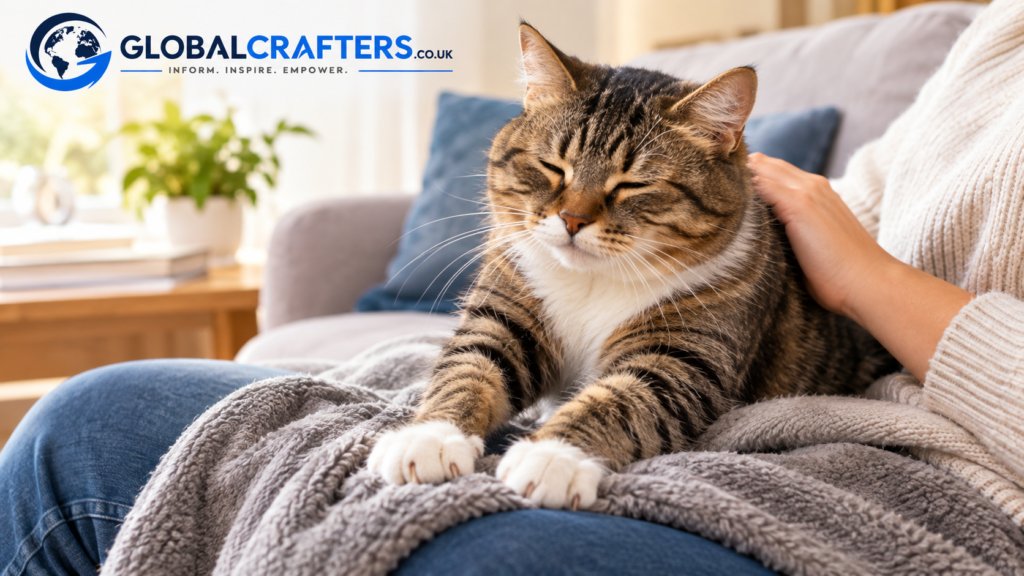

If your cat climbs onto your lap, settles beside you, and starts rhythmically pushing its front paws against your legs, you may wonder, why does my cat knead me? The behavior can be adorable, especially when it comes with purring, relaxed eyes, and a comfortable posture. At the same time, kneading can become surprisingly painful when your cat uses sharp claws.
Cat kneading is commonly called making biscuits because the repeated paw movement resembles someone kneading dough. Cats may knead blankets, pillows, clothing, beds, other animals, or their owners. Animal behavior sources generally consider it a normal feline behavior, particularly when the cat appears relaxed and comfortable.
The interesting part is that adult cats appear to retain a behavior that originally had an important purpose during kittenhood. Kittens knead around their mother’s mammary glands while nursing, helping stimulate milk flow. Some cats continue the movement later in life because it may be associated with comfort, relaxation, affection, scent marking, or preparing a comfortable resting area.
What Is Cat Kneading?
Cat kneading is a repetitive movement in which a cat alternates its front paws against a soft surface. One paw presses down while the other lifts, creating a rhythmic motion that can continue for several seconds or several minutes. Some cats extend their claws during the movement, while others keep their claws mostly covered.
Cats can knead almost anything that feels comfortable under their paws. A favorite blanket, cushion, bed, piece of clothing, stuffed toy, another cat, or a person’s lap can become the chosen surface. Cats Protection describes kneading as a retained juvenile behavior that is often seen in adult cats when they are content.
The behavior itself is not usually a problem. In fact, kneading is often associated with a relaxed cat. However, there is no single proven explanation for every instance of adult cat kneading. Experts describe several plausible reasons, which means your cat may knead you for more than one reason at the same time.
Why Does My Cat Knead Me?
The most likely answer is that your cat feels comfortable and safe around you. When a cat chooses your lap, stomach, chest, legs, or even your arm as a place to knead, it may be responding to the warmth, softness, familiar smell, and security associated with you.
Kneading is especially meaningful when it happens alongside other relaxed behaviors. Your cat may purr, half close its eyes, settle down, stretch its body, or eventually fall asleep. These signs can indicate that the cat is comfortable in the environment and enjoys the interaction. Cats Protection also identifies kneading and purring as behaviors commonly associated with contentment.
It is important not to interpret kneading as a single direct message such as “I love you.” Cat behavior is more complicated than that. However, if your cat regularly chooses you for kneading while displaying relaxed body language, it is reasonable to view the behavior as part of a positive relationship.
Why Do Cats Knead Their Owners?
One major explanation is that kneading is connected to kittenhood. Nursing kittens knead their mother’s abdomen around the mammary glands, and this action helps stimulate milk flow. The movement begins as an instinctive behavior associated with feeding and maternal contact.
As cats grow older, the original purpose of kneading disappears, but the behavior can remain. Your lap may provide a warm and soft surface that reminds your cat of the comfort associated with early life. This does not mean your adult cat literally thinks you are its mother. Instead, the movement may have become connected with a familiar feeling of comfort and security.
This is also why the idea that adult cats knead because they were separated from their mothers too early should be treated cautiously. Purina notes that the theory does not appear to explain the behavior because many cats knead regardless of their early history.
Why Do Cats Knead and Purr at the Same Time?
If your cat kneads you while purring, it may simply be deeply relaxed. Kneading and purring frequently occur together when cats are resting or receiving affection, making the combination particularly noticeable to owners.
A cat may climb onto your lap, begin kneading, start purring, and eventually curl up for a nap. This sequence fits the idea that kneading can be a comforting behavior. Veterinary sources note that cats commonly knead and purr when they are comfortable, although purring can also occur in other situations, including when a cat is trying to self soothe.
Because purring is not always a guarantee of happiness, it is better to consider the cat’s entire body language. Relaxed muscles, normal appetite, comfortable posture, calm behavior, and willingness to interact provide more useful context than purring alone.
Why Do Cats Knead Blankets and Clothes?
Soft materials are especially attractive to kneading cats. Blankets, fleece, pillows, bedding, sweaters, and other soft fabrics can provide the right texture for the repeated paw movement. A cat may choose these objects because they are comfortable and familiar.
There is also a theory that kneading may be connected to an instinct for preparing a comfortable resting place. Wild ancestors of domestic cats may have pawed at vegetation or other surfaces before settling down, although the precise evolutionary explanation for modern kneading is not established. Purina lists nest preparation as one possible explanation for the behavior.
Your cat may therefore knead a blanket before lying down because the behavior has become part of its relaxation routine. If the blanket also carries your scent, it can become especially attractive to a cat that associates your smell with familiarity and safety.
Why Does My Cat Knead Me With Its Claws?
Kneading with claws can make a sweet behavior considerably less comfortable. Your cat may push its paws into your skin while extending and retracting its claws during each movement. This can feel like a series of tiny scratches even when the cat has no intention of hurting you.
The claws are not necessarily being used aggressively. Cats may naturally extend their claws as part of the paw movement. Cats Protection notes that some cats extend and retract their claws during kneading, while veterinary guidance recommends keeping claws appropriately trimmed when they cause discomfort or damage.
You should avoid punishing the cat for this behavior. Kneading is generally instinctive, so shouting, pushing the cat away harshly, or frightening it can create unnecessary stress. A much better approach is to place a thick blanket or cushion between your cat and your skin.
Why Does My Cat Knead Me Before Sleeping?
Some cats knead immediately before taking a nap. You may notice your cat climb onto your lap, knead for a while, turn around several times, and then settle into a sleeping position.
This pattern may be connected with comfort and preparing a resting area. Cats naturally spend substantial amounts of time resting, and kneading can become part of an individual cat’s bedtime routine. The behavior may also be reinforced because the cat has learned that your lap is warm, familiar, quiet, and safe.
If your cat consistently kneads before sleeping and otherwise behaves normally, there is usually no reason to be concerned. It can simply be one of those repetitive routines that your cat has incorporated into its daily life.
Is Kneading a Sign That My Cat Loves Me?
Kneading can be associated with affection and trust, particularly when your cat chooses to knead on you while appearing relaxed. Cats do not usually knead only because they want to communicate affection, but choosing a person’s lap can indicate that the cat is comfortable interacting with that person.
Veterinary guidance from VCA notes that cats may knead human and nonhuman family members as an expression associated with comfort and affection. Cats Protection similarly describes kneading as a behavior associated with contentment.
Rather than looking at kneading alone, consider the broader relationship. If your cat approaches you voluntarily, rests near you, slow blinks at you, rubs against you, sleeps near you, and kneads you while relaxed, these behaviors together can indicate a strong level of comfort and familiarity.
Does Kneading Mean My Cat Is Happy?
In many everyday situations, kneading is associated with a comfortable and content cat. A relaxed cat may knead a soft surface while purring, stretching, or preparing to sleep. This is why many owners consider “making biscuits” one of the most charming cat behaviors.
Cats Protection identifies adult kneading as a common sign of contentment, while VCA explains that cats usually knead when comfortable.
However, it is important not to assume that every instance of kneading automatically means happiness. Cats can sometimes purr and knead as self soothing behaviors when they are uncomfortable. The location, frequency, intensity, and other behaviors should therefore be considered together.
Can Kneading Be a Way for Cats to Mark You?
Another possible explanation for kneading is scent marking. Cats have scent glands around their paws and claws, and paw movements may help transfer their scent to surfaces.
If your cat repeatedly kneads your lap, it may be combining comfort with familiar scent marking. Cats use scent extensively to understand and communicate information about their environment. Marking can help make an area feel familiar and safe to them.
This does not necessarily mean your cat is trying to “claim” you in a dramatic sense. It is better understood as part of normal feline scent communication. Your cat may simply be reinforcing a familiar environment that includes you.
Why Does My Cat Knead Me More Than Other People?
Cats can develop different relationships with different people. Your cat may choose you more often because your lap is comfortable, you spend more time with the cat, you provide food, or your behavior feels predictable and reassuring.
Your clothing and natural scent can also influence where your cat chooses to settle. Cats rely heavily on smell, and familiar scents can be associated with safety. Cats Protection explains that cats can associate familiar human scent with a safe and trusted environment.
This means that if your cat ignores another person’s lap but immediately starts kneading yours, there may be a simple explanation: your cat has developed a particularly strong comfort association with you.
Why Does My Cat Knead and Then Bite Me?
Kneading followed by biting can be confusing because the first behavior may look affectionate. In some cases, the bite is simply part of overstimulation, excitement, play behavior, or an individual cat’s interaction style.
Pay attention to the type of bite and the cat’s body language. A gentle nibble accompanied by relaxed behavior is different from a hard bite accompanied by flattened ears, tense muscles, growling, hissing, or rapid tail movement.
If petting or touching your cat appears to trigger the behavior, give the cat some space and avoid forcing continued interaction. Cats have individual tolerance levels for physical contact, and learning those signals can help prevent an otherwise pleasant interaction from becoming stressful.
Why Does My Cat Knead My Stomach or Chest?
A cat may knead your stomach or chest simply because those areas are warm, soft, and comfortable. Cats often choose surfaces that provide a pleasant texture and stable support for their paws.
Your breathing and body warmth may also make these areas attractive when your cat wants to settle down. If the cat is relaxed and chooses to remain there, the behavior is generally consistent with normal comfort seeking.
There is no evidence that kneading your stomach or chest has a special universal meaning compared with kneading your legs or lap. Individual cats develop their own preferences, and the context matters more than the exact body location.
Why Does My Cat Knead My Legs?
Your legs can provide a convenient surface when your cat is sitting beside you or climbing onto the furniture. Kneading may happen when the cat is relaxing, greeting you, settling down, or seeking physical contact.
If your cat kneads your legs while standing or lying beside you, it does not necessarily indicate a problem. The same basic explanations apply: kittenhood instinct, comfort, relaxation, affection, scent marking, or preparation for rest.
If the claws make the behavior painful, place a blanket between your legs and the cat. Redirecting the behavior is usually preferable to trying to eliminate kneading altogether.
Why Do Some Cats Knead More Than Others?
Not every cat kneads with the same frequency. Some cats knead almost every day, while others may do it only occasionally. Some cats knead people, while others prefer blankets or beds.
Individual personality, learned routines, preferred textures, environment, and the cat’s relationship with its owner can all influence how often the behavior appears. There is no requirement for a healthy adult cat to knead a particular number of times.
The important thing is to know what is normal for your own cat. A sudden major change in behavior deserves more attention than a long established kneading habit that has remained consistent for years.
Is It Normal for an Adult Cat to Knead?
Yes. Adult cats can continue kneading even though the original kittenhood function is no longer necessary. The behavior can remain as a comforting or instinctive action.
Cats Protection describes adult kneading as a retained juvenile behavior, while VCA explains that the behavior can continue into adulthood even though cats no longer need to knead their mother to stimulate milk flow.
There is no need to stop a cat from kneading simply because it is an adult. If the behavior is harmless and the cat appears relaxed, it can be allowed as part of normal feline behavior.
When Should You Be Concerned About Kneading?
Most kneading is harmless, but a sudden change can be worth observing. If a cat that rarely kneads suddenly begins kneading excessively, especially while hiding, eating differently, becoming unusually vocal, or showing other changes, the behavior should be considered in context.
VCA notes that cats may sometimes knead and purr as self soothing behaviors when they are not feeling well. A cat kneading in an unusual location while hiding or showing other changes in behavior may warrant veterinary attention.
The key point is not that kneading itself is dangerous. Instead, unusual kneading combined with other changes can be one small part of a larger behavioral picture. If you are concerned about a sudden behavioral change, contact a veterinarian who can evaluate your cat properly.
How Can I Stop My Cat From Hurting Me While Kneading?
You do not necessarily need to stop your cat from kneading. Instead, you can make the behavior more comfortable for both of you. The easiest solution is to keep a soft blanket or cushion nearby and place it over your lap whenever your cat begins making biscuits.
Regular claw care can also reduce accidental scratches. VCA recommends keeping claws trimmed when kneading becomes uncomfortable or causes damage to people or furniture.
Another option is gentle redirection. If your cat starts kneading your bare skin, calmly guide it toward a blanket, pillow, or designated soft surface. Avoid yelling or physically punishing the cat because the behavior is instinctive and the cat may not understand why it is being punished.
How Should You Respond When Your Cat Kneads You?
If the kneading is comfortable, there is usually no reason to stop it. You can allow your cat to continue while watching its body language. Gentle petting may be appropriate if your cat enjoys being touched.
If the claws are painful, calmly place a blanket between you and the cat. You can also move the cat toward a nearby soft surface without making the interaction frightening.
The goal is not to eliminate a normal behavior but to create a situation where both you and your cat are comfortable. Cats learn through repeated experiences, so consistently redirecting painful kneading toward an appropriate surface can become part of the cat’s routine.
Conclusion
So, why does my cat knead me? In most cases, the answer is connected to comfort, instinct, and familiarity. Kneading begins as a kitten behavior associated with nursing, but some cats carry the movement into adulthood. As adults, cats may knead because it feels comforting, helps them settle down, provides a familiar routine, or accompanies positive interactions with people they trust.
When your cat climbs onto your lap, purrs, relaxes, and starts making biscuits, there is usually no reason to worry. Your cat may simply be enjoying a comfortable moment with you. Kneading can also involve scent communication and may be directed toward blankets, clothing, beds, or other soft surfaces.
If the claws hurt, you do not have to tolerate painful scratches. A soft blanket, regular claw care, and gentle redirection can make the experience more comfortable without discouraging your cat from expressing a normal behavior.
The most important thing is to consider kneading as part of your cat’s overall behavior. A relaxed cat that has always kneaded is generally very different from a cat that suddenly changes its behavior and shows other signs of discomfort. When a significant behavioral change occurs, veterinary advice can help determine whether something else is happening.
You may also read more blogs
Frequently Asked Questions About Cat Kneading
Why does my cat knead me?
Your cat may knead you because the behavior is connected to kittenhood, comfort, relaxation, affection, scent marking, or preparing a comfortable resting place. Adult kneading is common and generally normal.
Does my cat knead me because it loves me?
Kneading can occur when a cat feels comfortable and affectionate toward a person. It is better to consider it alongside other relaxed behaviors rather than treating it as a single definitive sign of love.
Why does my cat knead me with its claws?
Cats may naturally extend and retract their claws while kneading. This does not usually mean they are trying to hurt you. A blanket can provide protection if the claws are painful.
Why does my cat knead and purr?
Kneading and purring often occur when cats are relaxed and comfortable. However, purring can have several meanings, so the cat’s overall body language should also be considered.
Why does my cat knead blankets?
Soft blankets provide a comfortable surface for kneading. The behavior may also be related to relaxation and an instinctive tendency to prepare a resting area.
Should I stop my cat from kneading?
Usually, no. Kneading is a normal behavior. If it hurts, use a blanket as a barrier, maintain appropriate claw care, or gently redirect your cat to a soft surface.
Is excessive kneading a sign of illness?
Kneading itself is usually not a sign of illness. However, a sudden increase in kneading combined with hiding, appetite changes, unusual vocalization, aggression, or other behavioral changes may deserve veterinary attention.
Why does my cat knead before sleeping?
Your cat may knead before sleeping because the behavior is comforting or because it has become part of its routine for settling down. Many cats knead soft surfaces before resting.