
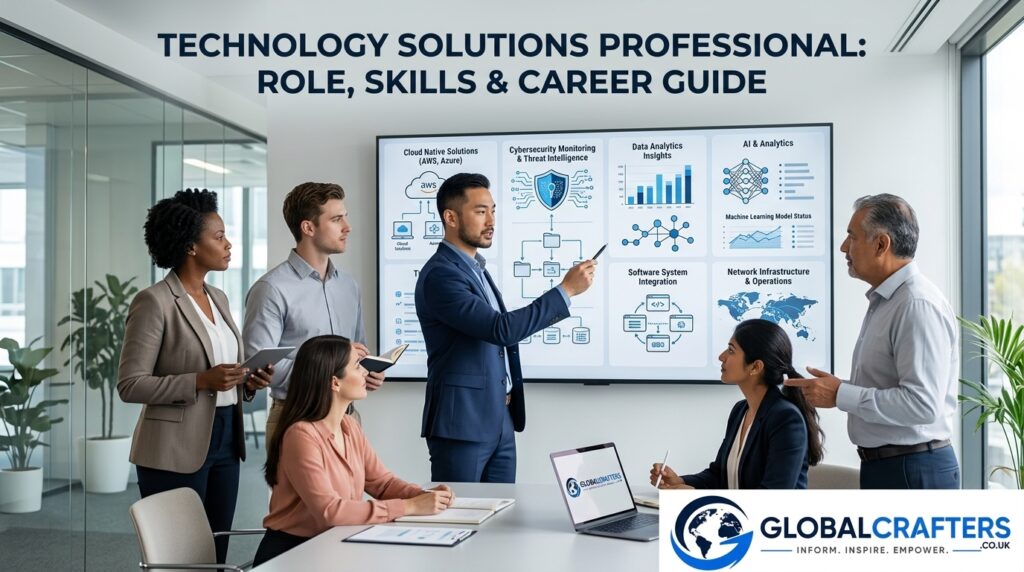

A technology solutions professional is an IT and technology specialist who helps organisations turn business challenges into practical technology solutions. Rather than focusing on one isolated system, this professional typically looks at the wider problem, assesses existing technology, identifies gaps and recommends or designs solutions that support measurable business objectives. Depending on the organisation, the role can overlap with solutions architecture, technical consulting, pre sales engineering, systems integration and digital transformation. The term is therefore broader than a single job title and can describe professionals working across several areas of modern enterprise technology.
The central responsibility is to connect business requirements with technical possibilities. For example, a company might want to reduce manual administration, improve cybersecurity, move applications to the cloud or create better access to business data. A technology solutions professional evaluates the requirement, considers technical and operational constraints, compares suitable approaches and helps turn the selected strategy into a functioning solution. This business to technology bridge is what makes the role valuable, particularly for organisations dealing with increasingly complex technology environments.
What Does a Technology Solutions Professional Do?
The exact responsibilities depend on the employer, industry and seniority of the position. Some professionals concentrate on customer facing consulting and pre sales, while others become involved directly in architecture, implementation or technology strategy. A current example of the role in Pakistan is a technology solutions position focused on cybersecurity transformation, where responsibilities include technical discovery, security workshops, solution briefings, assessments, roadmaps, proof of concept work and implementation planning.
Business and technology assessment
The process usually starts with understanding the problem rather than immediately recommending a product. A technology solutions professional may speak with managers, IT teams and other stakeholders to understand existing workflows, technology limitations, security concerns, costs and desired outcomes. They may review infrastructure, applications, data flows and business processes to identify weaknesses or opportunities.
This assessment is important because the most expensive technology is not automatically the best solution. A smaller organisation may need a straightforward cloud application rather than a complex enterprise platform, while a large organisation may require integration between multiple systems. Effective professionals therefore consider business requirements, technical feasibility, scalability, security and total cost before recommending an approach.
Solution design and planning
After identifying the requirements, the professional develops a practical technology strategy or solution design. This may involve selecting cloud services, software platforms, cybersecurity controls, databases, networking technologies or integration methods. The design should explain how different components work together and how the proposed system supports the organisation’s objectives.
Depending on the role, this can include architecture diagrams, technical specifications, implementation roadmaps, cost estimates, risk assessments and proof of concept demonstrations. Customer facing professionals may also work closely with sales teams to demonstrate how a proposed technology can address a client’s specific requirements.
Implementation and integration
Designing a solution is only part of the job. Technology solutions professionals may coordinate or participate in implementation to ensure that the proposed system works within the organisation’s existing environment. Integration can be particularly important when businesses use multiple applications that need to exchange information.
For example, an organisation might need its customer relationship management platform to communicate with an accounting system and an online sales platform. A technology professional can help define the integration architecture, identify compatibility issues and coordinate with developers, engineers or vendors during deployment.
Ongoing optimisation and support
Technology environments change continuously. New security threats emerge, software platforms evolve, businesses grow and user requirements change. As a result, a technology solution may require monitoring, optimisation and periodic redesign after implementation.
A strong professional therefore considers the full technology lifecycle rather than treating deployment as the final objective. Performance, reliability, security, scalability and user adoption can all influence whether a technology investment produces the expected business value.
Key Areas of Technology Solutions
A technology solutions professional can work across several technical disciplines. The exact combination depends on their specialisation.
Cloud computing
Cloud technology is a major area of modern technology consulting. Professionals may help businesses evaluate cloud platforms, plan migrations, design hybrid environments or improve the reliability and security of existing cloud workloads.
Cloud related responsibilities can include architecture planning, identity management, storage, networking, backup, disaster recovery and cost optimisation. Professionals may work with platforms such as Microsoft Azure, Amazon Web Services or other enterprise cloud technologies.
Cybersecurity
Cybersecurity is another important area, particularly as organisations increasingly depend on connected applications, cloud platforms and remote access. A technology solutions professional specialising in security may assess risks and recommend controls involving identity, endpoint protection, network security, data protection, security monitoring and incident response.
Modern security solution design can also involve concepts such as Zero Trust, SIEM, SOAR, XDR and cloud security. These technologies require professionals to understand not only individual products but also how security controls interact across an organisation’s technology environment.
Software and systems integration
Businesses rarely operate using one application. They may rely on accounting software, CRM platforms, HR systems, websites, mobile applications and industry specific tools. Integration specialists help these systems communicate efficiently.
A technology solutions professional may analyse APIs, databases, middleware and data flows to determine how applications should exchange information. Good integration can reduce duplicate data entry, improve accuracy and create more efficient workflows.
Data and artificial intelligence
Data platforms and artificial intelligence are expanding the scope of technology solution design. Businesses increasingly want to use their operational data for reporting, forecasting, automation and decision making.
Professionals working in this area may help organisations evaluate data architecture, analytics platforms, AI applications and governance requirements. The goal is not simply to introduce AI but to determine where it can provide practical value while considering security, privacy, reliability and integration.
Network and infrastructure
Infrastructure remains fundamental to technology operations. Depending on their specialisation, technology solutions professionals may work with servers, networking, storage, endpoint environments and enterprise infrastructure.
Their work can involve modernising legacy systems, improving reliability, planning capacity or creating infrastructure that can support new applications and services.
Skills a Technology Solutions Professional Needs
The role requires more than technical knowledge. Professionals need to understand how technology decisions affect people, processes, budgets and business objectives.
Technical skills
Useful technical capabilities include systems architecture, cloud computing, networking, cybersecurity, databases, software integration and IT infrastructure. The required depth varies by specialisation, but professionals should be capable of understanding how different technologies interact.
Problem solving is equally important. A client may describe a business problem without knowing its technical cause, so the professional must investigate the underlying issue before developing an appropriate solution.
Business and analytical skills
Technology recommendations have financial and operational consequences. A professional should therefore understand requirements gathering, cost analysis, risk management, project planning and business processes.
Analytical thinking helps them compare alternative solutions rather than recommending the first technology that appears suitable. The strongest approach considers functionality alongside security, scalability, maintainability, implementation complexity and long term value.
Communication and collaboration
Communication is one of the most important non technical skills in this profession. Technology solutions professionals often work with executives, sales teams, developers, engineers, vendors and customers.
They must be able to explain technical concepts to non technical decision makers without unnecessary jargon. In customer facing roles, they may also deliver presentations, technical demonstrations, workshops and proof of concept sessions.
Technology Solutions Professional vs Related IT Roles
The title can overlap with several established technology positions, but there are useful distinctions.
| Role | Typical focus |
|---|---|
| Technology Solutions Professional | Connecting business requirements with practical technology solutions |
| Solutions Architect | Designing the technical architecture of a solution |
| Technical Consultant | Advising clients on technology and implementation |
| Solutions Engineer | Often combines technical expertise with customer facing pre sales work |
| IT Specialist | Managing or supporting a specific technology area |
The boundaries are not fixed. A technology solutions professional may perform responsibilities associated with several of these roles depending on the organisation. For example, a customer facing professional may participate in technical discovery and demonstrations, while a senior specialist may also create architecture and oversee implementation.
Qualifications and Certifications
There is no single qualification that universally defines a technology solutions professional. Employers commonly look for a relevant degree or equivalent technical experience, depending on the role. Suitable academic backgrounds can include computer science, information technology, software engineering, information systems or related disciplines.
Professional certifications can strengthen a candidate’s profile, particularly when they align with the technologies used by the employer. Examples include cloud, networking, cybersecurity and enterprise platform certifications. Microsoft’s role profiles and apprenticeship frameworks also demonstrate how broad digital and technology solutions careers can span software, systems analysis, cybersecurity, data analysis and network infrastructure.
Practical experience is equally valuable. Building projects, supporting IT environments, participating in implementations and documenting technical solutions can demonstrate capabilities that a qualification alone cannot.
How to Become a Technology Solutions Professional
A practical career path often begins with developing strong fundamentals in IT. Learn networking, operating systems, databases, cybersecurity concepts and software systems before moving into more specialised technologies.
The next step is to gain hands on experience. Entry level IT support, systems administration, software development, cloud support or technical consulting roles can provide valuable exposure to real world technology environments. From there, you can specialise in areas such as cloud architecture, cybersecurity, data, enterprise applications or systems integration.
Developing communication skills should happen alongside technical development. A professional who can explain why a solution is appropriate, what risks it involves and how it supports business objectives can create significantly more value than someone who only understands the technology itself.
Building a portfolio can also help. Instead of simply listing technologies on a CV, document projects showing the problem, requirements, solution architecture, implementation approach and outcome. This gives employers evidence of practical solution thinking.
Why Businesses Need Technology Solutions Professionals
Businesses increasingly depend on interconnected technology systems, which makes technology decisions more complicated. Choosing software without considering integration, security, scalability or user requirements can create expensive problems later.
A technology solutions professional helps reduce this complexity by taking a broader view. Instead of asking only, “Which technology should we buy?”, they consider questions such as what problem needs solving, how the solution fits existing systems, what risks it creates, how users will adopt it and how the organisation can maintain it over time.
This approach can support digital transformation, operational efficiency, cybersecurity improvements and better technology investment decisions. Technology solution providers similarly position their work around areas such as cloud, infrastructure, cybersecurity, AI and data, professional services and managed support.
Career Opportunities and Growth
Technology solutions professionals can work in technology companies, consulting firms, system integrators, managed service providers and internal IT departments. Career opportunities may include solutions architect, technical consultant, solutions engineer, cloud consultant, cybersecurity consultant, enterprise technology consultant or technical account specialist.
The career can also develop vertically into senior consulting, architecture, technology strategy or leadership. Alternatively, professionals can deepen their expertise in a specific field such as cloud security, enterprise applications, data architecture or AI solutions.
Because the title is broad, candidates should pay close attention to individual job descriptions rather than relying on the title alone. One employer may use the term for a pre sales technical position, while another may expect architecture and implementation expertise. Current job listings illustrate this variation clearly.
How to Choose the Right Technology Solution
Selecting technology should begin with the business problem, not a product catalogue. Organisations should clearly define the desired outcome, current limitations, users, budget, security requirements and integration needs before comparing solutions.
A good evaluation should consider functionality, scalability, reliability, security, implementation requirements, vendor support and total cost of ownership. It is also useful to identify how the solution will be measured after implementation. For example, a project designed to improve productivity should have meaningful performance indicators rather than being judged simply by whether the software was successfully installed.
A technology solutions professional can bring these considerations together and create a structured decision making process. This is especially valuable for organisations where technical decisions have long term financial and operational consequences.
Conclusion
A technology solutions professional is ultimately a bridge between business challenges and technical execution. The role goes beyond knowing how individual technologies work; it requires understanding why a business needs a solution, how different systems should work together and what outcome the organisation expects.
For professionals, this makes the career path flexible because skills can lead into cloud, cybersecurity, architecture, consulting, data, software integration or technology strategy. For businesses, the value lies in making technology decisions more structured, secure and aligned with measurable objectives. As technology environments become more interconnected, professionals who can combine technical knowledge with business understanding and clear communication are well positioned to play an important role in digital transformation.
You may also read more blogs
Instructional Technology Services
Frequently Asked Questions
What is a technology solutions professional?
A technology solutions professional helps organisations identify technology needs and design, implement or manage solutions that address business problems. The role can cover areas such as cloud computing, cybersecurity, software integration, infrastructure, data and digital transformation.
What does a technology solutions professional do?
They typically assess business requirements, analyse existing technology, design solutions, evaluate platforms, support implementation, coordinate with technical teams and help optimise systems after deployment. Responsibilities vary considerably by employer and specialisation.
Is a technology solutions professional the same as a solutions architect?
Not necessarily. A solutions architect usually focuses heavily on technical architecture, while a technology solutions professional can have a broader role covering business analysis, consulting, pre sales, implementation and solution strategy.
What skills are needed for a technology solutions professional?
Important skills include technical problem solving, systems architecture, cloud and infrastructure knowledge, cybersecurity awareness, analytical thinking, project understanding and strong communication. Business knowledge is also important because solutions must support organisational objectives.
What degree is best for a technology solutions professional?
Computer science, information technology, software engineering and information systems are relevant degree options. However, practical experience, technical certifications and demonstrated project work can also be important depending on the employer and position.
Can a technology solutions professional work in cybersecurity?
Yes. Cybersecurity is one of the areas in which technology solutions professionals can specialise. Security focused roles may involve cloud security, identity management, threat protection, data security, security monitoring and broader security transformation.
Are technology solutions professional jobs in demand?
Technology organisations continue to recruit for roles that combine technical expertise with consulting, architecture, customer engagement and implementation skills. However, demand varies by technology, industry, location and experience level, so candidates should assess specific job descriptions rather than relying on the title alone.
How can I become a technology solutions professional?
Start with strong IT fundamentals, gain practical experience and specialise in an area such as cloud, cybersecurity, software integration or data. Develop communication and business analysis skills alongside technical expertise, then build a portfolio that demonstrates real solution design and problem solving.