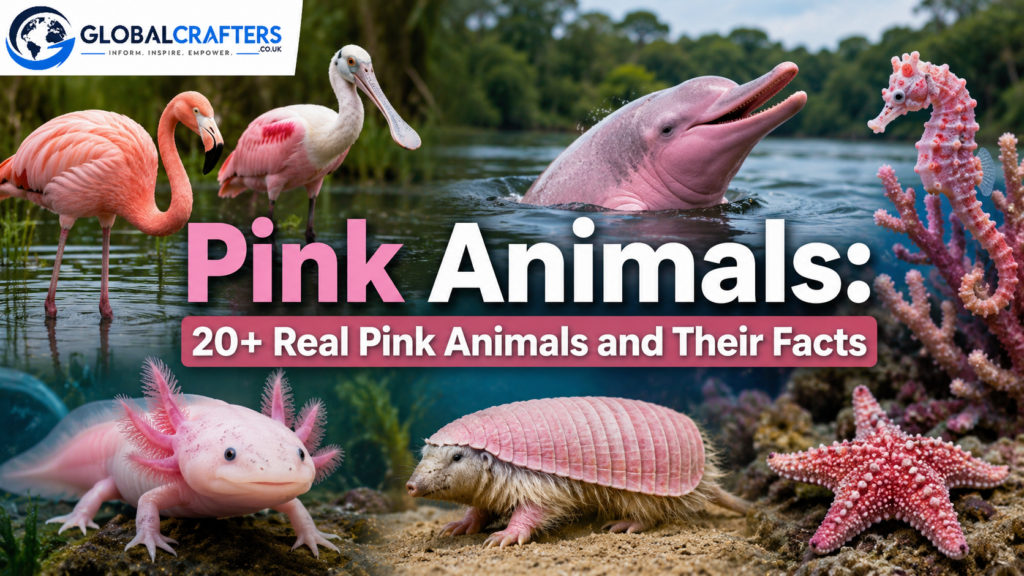

Pink Animals: Pink not one of the most common colours in the animal kingdom. Browns, greens, greys and blacks often dominate because they can help animals blend into forests, grasslands, deserts and oceans. Yet nature produces plenty of genuine pink animals, ranging from iconic flamingos and roseate spoonbills to tiny seahorses, unusual insects and even a freshwater dolphin.
The interesting part is that pink does not have a single biological explanation. Some animals become pink because of pigments in their food, while others have genetic colour variations. In some species, pink comes from blood vessels close to the skin, and in others it is an important part of camouflage.
Here is a closer look at real pink animals, why they have their unusual colour and what makes each one fascinating.
Why Are Some Animals Pink?
Pink coloration can develop through several different biological mechanisms. One of the best known examples is the flamingo, whose feathers become pink because its diet contains carotenoids. These natural pigments occur in algae and small crustaceans and are processed by the bird before being deposited in its feathers.
Genetics can produce pink coloration too. Pink katydids, for example, can have a condition known as erythrism, which changes normal pigmentation and produces an unusually pink appearance. Unlike flamingos, their colour is not simply the result of eating particular foods.
Other animals look pink because of their anatomy. The pink fairy armadillo has a soft pink shell because numerous blood vessels lie close to the surface of its flexible carapace. The species is also exceptionally small, reaching only about 6 inches in length.
Camouflage is another explanation. Bargibant’s pygmy seahorse can have rosy coloration and a knobby body that closely matches the gorgonian sea fans where it lives. At roughly 2 centimetres long, it can be extraordinarily difficult to see.
So, a pink animal is not necessarily pink for the same reason as another pink animal. The colour can tell a very different biological story from species to species.
Pink Animals You Can Find in Nature
Pink animals occur across almost every major animal group. Some are unmistakably pink throughout their lives, while others develop pink coloration with age, diet or particular genetic traits.
Pink Birds
Flamingo: Flamingos are probably the most famous pink animals on Earth. Their pink and reddish plumage comes largely from carotenoid pigments obtained through their food, including algae and small crustaceans. Flamingo chicks are initially greyish or white and gradually develop their characteristic colour as they grow. At the Smithsonian’s National Zoo, flamingo plumage becomes noticeably pink during the first year and can deepen over subsequent years.
Roseate spoonbill: This striking wetland bird is sometimes mistaken for a flamingo because of its pink feathers and long legs. Its scientific name is Platalea ajaja, and its broad, spoon shaped bill is specially adapted for sweeping through shallow water in search of prey. Its pink feathers are associated with carotenoids in crustaceans and other aquatic food.
Galah: The galah is an Australian cockatoo with a pink chest and face, a grey back and a lighter crown. Unlike the flamingo, its pink appearance is not primarily famous for being a dietary pigment effect; it is part of the bird’s natural plumage pattern.
Pink robin: Found in southeastern Australia, the male pink robin is recognizable by its vivid pink breast contrasted with a darker upper body. It demonstrates that pink plumage can occur in relatively small forest birds as well as large wetland species.
Pink Mammals
Amazon river dolphin: The Amazon river dolphin, also called the boto or pink river dolphin, is one of the world’s most unusual pink mammals. Young animals are generally darker grey, while adults can develop a pink or blotched pink appearance. Males are often more strongly pink than females. The species lives in freshwater systems across much of the Amazon and Orinoco basins.
The colour of these dolphins can vary considerably, so not every individual looks bright pink. Their populations also face serious pressures from river pollution, dams, fishing interactions and habitat changes.
Pink fairy armadillo: This tiny armadillo is one of the strangest looking pink animals. It lives in central Argentina and is the smallest armadillo species. Its pink shell is associated with blood vessels close to the surface, while its fur helps provide insulation. It is nocturnal and spends much of its life underground, which makes it extremely difficult to study.
Naked mole rat: Naked mole rats have little visible hair and relatively translucent skin, which can give them a pink or rosy appearance. They live underground in highly social colonies and are adapted to life in dark tunnel systems.
Pink Amphibians and Reptiles
Axolotl: The axolotl is a Mexican salamander famous for retaining its juvenile features throughout adulthood, including external gills. Many captive axolotls are pale pink or white, particularly leucistic and albino forms. Importantly, leucistic does not mean albino: a leucistic axolotl generally has reduced pigmentation but can retain dark eyes, while albino animals lack melanin and commonly have pink or red eyes.
The pink axolotl commonly seen in aquariums is therefore not representative of the wild type coloration. Wild axolotls are typically much darker, with brown, grey or olive tones.
Galápagos pink land iguana: This is one of the rarest and most remarkable pink reptiles. The Galápagos pink land iguana, Conolophus marthae, was scientifically described in 2009 and is restricted to the northern slopes of Volcán Wolf on Isabela Island. The IUCN has listed it as Critically Endangered, with a very small wild population.
Pink Insects and Other Invertebrates
Pink katydid: Pink katydids are unusual colour variants produced by erythrism, a genetic condition that alters normal pigmentation. Their bright colour makes them much more conspicuous than the green or brown forms people usually associate with katydids.
Orchid mantis: The orchid mantis, Hymenopus coronatus, is a Southeast Asian insect whose pink and white appearance can resemble flower petals. Its body shape and coloration contribute to remarkable visual mimicry around flowers.
Pink dragon millipede: Discovered in Thailand in 2007, the pink dragon millipede is notable for its vivid pink appearance and chemical defence. Unlike a harmless looking garden millipede, this species can release cyanide compounds when threatened.
Pink sea star: Several sea star species can appear pink, ranging from pale blush to stronger reddish pink tones. Their coloration varies by species and individual, demonstrating that pink is not limited to land animals.
Pink Marine Animals
Bargibant’s pygmy seahorse: This tiny fish is a master of camouflage. It lives among gorgonian sea fans and can closely match their colour and texture. It grows to around 2 centimetres and was first recognized after a gorgonian coral specimen was collected and examined.
Pink nudibranchs: Nudibranchs are marine molluscs famous for spectacular colours and patterns. Some species display vivid pink, magenta or pink purple tones, often combined with contrasting structures that make them particularly noticeable on coral reefs.
Hairy squat lobster: This small crustacean is associated with coral reef environments and is often pink, orange or reddish in appearance. Its compact body and hairy appendages make it one of the more unusual examples in the marine world.
Which Pink Animals Are the Rarest?
Not every pink animal is rare simply because it is pink. Flamingos, for example, are widespread in suitable wetland habitats, and roseate spoonbills occur across large parts of the Americas. Their pink colour is unusual compared with many other birds, but it is a normal characteristic of the species.
The situation is different for animals such as pink katydids, where the colour can result from an uncommon genetic condition. The Galápagos pink land iguana is rarer still because the entire species has an extremely restricted natural range and a small population.
The pink fairy armadillo is another animal that is difficult to encounter. Its underground lifestyle, nocturnal habits and restricted distribution mean that even researchers have limited opportunities to observe it in the wild.
Pink Colouration as an Adaptation
Pink coloration can serve very different purposes depending on the animal.
For flamingos and roseate spoonbills, pink is closely connected to dietary carotenoids. These pigments become incorporated into feathers, meaning that food availability can influence the intensity of their colour.
For the pygmy seahorse, colour is part of an extraordinary camouflage system. Matching the host sea fan can make the tiny animal extremely difficult for predators and observers to detect.
The orchid mantis provides another fascinating example because its pink-and-white appearance can resemble a flower. Instead of simply disappearing against the background, the insect’s appearance is associated with its specialised relationship with flowering vegetation and prey.
In other animals, pink may simply be a consequence of anatomy or inherited pigmentation rather than an adaptation with one obvious function. The pink fairy armadillo’s shell, for instance, looks pink partly because of blood vessels close to the surface.
Are Pink Animals Endangered?
Some pink animals face significant conservation challenges, but their colour is not necessarily the reason.
The Galápagos pink land iguana is a particularly important example. Its extremely restricted distribution on Volcán Wolf leaves the species vulnerable to environmental changes and local threats, including invasive species. The IUCN has classified it as Critically Endangered.
Amazon river dolphins also face conservation pressures. Dams can fragment populations, while pollution—including mercury contamination associated with gold mining—can enter aquatic food webs. In some areas, dolphins are also deliberately killed in connection with fishing activities.
The conservation lesson is broader than pink coloration. Protecting wetlands, rivers, forests and coral reefs helps preserve the habitats on which these unusual animals depend. A colourful species can attract public attention, but its long term survival usually depends on protecting an entire ecosystem.
Final Thoughts
Pink animals show how much more varied nature is than the familiar greens, browns and greys we often associate with wildlife. A flamingo gets its colour from carotenoid rich food, a pygmy seahorse uses pinkish camouflage to disappear among sea fans, an axolotl can display pale pigmentation because of genetics, and a pink fairy armadillo owes much of its rosy shell to blood vessels near the surface.
The most fascinating lesson is that pink is not a single adaptation. It can be a product of diet, genetics, anatomy, age or camouflage. Understanding the reason behind the colour makes these animals more than attractive subjects for photographs it reveals the
You may also read more blogs
Frequently Asked Questions About Pink Animals
What is the most famous pink animal?
The flamingo is probably the most recognizable pink animal. Its characteristic pink plumage develops from carotenoid pigments obtained through its diet, particularly algae and small crustaceans.
Are pink animals real?
Yes. Many animals naturally have pink or pinkish coloration. Examples include flamingos, roseate spoonbills, Amazon river dolphins, pink fairy armadillos, axolotls, pink katydids and several marine species
Why are flamingos pink?
Flamingos become pink because they consume foods containing carotenoids. Their bodies process these pigments and deposit them into their feathers. Young flamingos are initially greyish or white before developing adult coloration.
Is the pink axolotl an albino?
Not necessarily. Pale pink or white axolotls can represent different genetic colour forms. Leucistic axolotls generally have reduced pigmentation and often retain dark eyes, while albino axolotls lack melanin and commonly have pink or red eyes.
Are pink dolphins actually pink?
Yes. Adult Amazon river dolphins can develop pink or blotched pink coloration, although individuals vary and young dolphins are generally darker grey. Adult males tend to be more strongly pink than females.
What is the rarest pink animals?
There is no single universally accepted “rarest pink animal,” but the Galápagos pink land iguana is among the most exceptional examples because it has a highly restricted range and a very small wild population. It is classified as Critically Endangered.
Can pink animals change colour?
Some can. Flamingos develop their adult pink colour as they mature and consume carotenoid rich foods. Amazon river dolphins can also become pinker with age. Other species may show colour variation because of genetics or environmental factors.
Do pink animals need pink food to stay pink?
Not always. In flamingos and some other birds, diet is directly important because carotenoid pigments contribute to their coloration. But animals such as pink fairy armadillos and pink genetic colour variants have different biological mechanisms behind their appearance.