
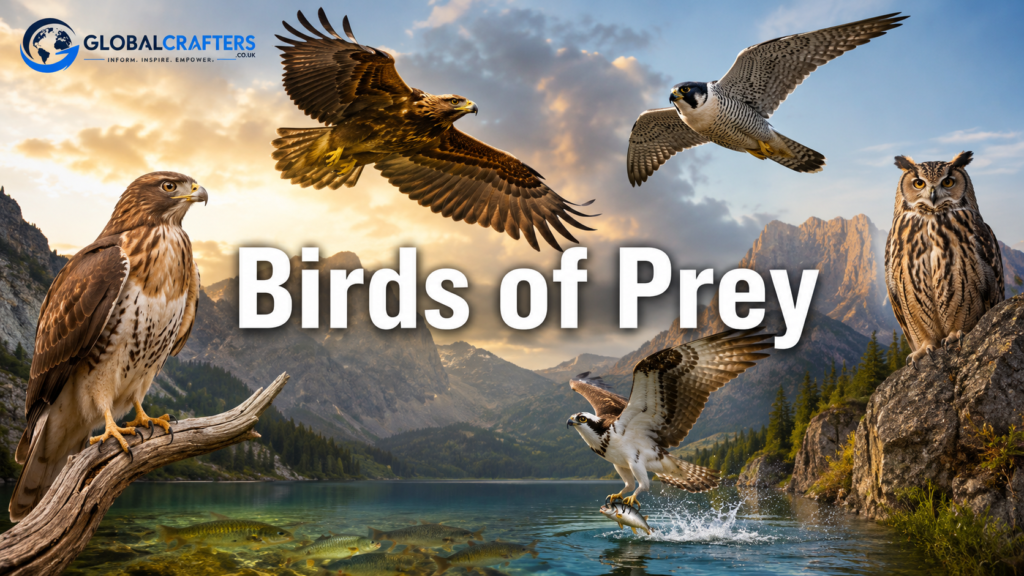

Birds of prey are among the most specialised predators in the animal kingdom. Eagles, hawks, falcons, kites, Ospreys, owls and vultures all belong to the broad group commonly called raptors, although they differ greatly in appearance, behaviour and hunting technique.
From a Peregrine Falcon pursuing another bird at extraordinary speed to an Osprey diving into water for a fish, birds of prey have evolved specialised adaptations for finding, catching or consuming food. They also play important ecological roles by regulating prey populations and, in the case of vultures, removing carrion from the environment.
What Are Birds of Prey?
Birds of prey, also known as raptors, are predatory birds adapted for obtaining food through specialised hunting or feeding behaviours. Typical characteristics include strong grasping feet, sharp talons, hooked bills and highly developed senses.
However, “raptor” is not simply a taxonomic family. Hawks and falcons, for example, are not close relatives even though both are traditionally considered birds of prey. Modern discussions of raptor classification recognise several different bird lineages within the broader concept.
Commonly recognised birds of prey include:
- Eagles
- Hawks
- Falcons
- Kites
- Harriers
- Ospreys
- Owls
- Vultures
Their diets and hunting methods vary considerably. An Osprey specialises in catching fish, while many hawks hunt small mammals and some falcons specialise in catching other birds. Vultures, meanwhile, are highly adapted to scavenging rather than regularly killing live prey.
Main Types of Birds of Prey
Birds of prey are not one uniform group. Their body shapes and behaviours reflect the environments and food sources they have evolved to exploit.
| Type | Typical hunting or feeding style | Example |
|---|---|---|
| Eagles | Powerful hunting and soaring | Golden Eagle |
| Hawks | Perching, soaring and ambush hunting | Red tailed Hawk |
| Falcons | Fast aerial pursuit | Peregrine Falcon |
| Kites | Soaring and opportunistic hunting | Red Kite |
| Harriers | Low level hunting over open ground | Hen Harrier |
| Ospreys | Diving for fish | Osprey |
| Owls | Low light or nocturnal hunting | Barn Owl |
| Vultures | Scavenging carrion | Turkey Vulture |
Cornell Lab of Ornithology’s taxonomy resources, for example, list hawks and eagles within Accipitridae, falcons and caracaras within Falconidae, Ospreys in Pandionidae, and owls within Strigiformes.
Adaptations That Make Raptors Effective Hunters
The most obvious raptor adaptations are their talons and hooked bills. Talons help many species seize and hold prey, while the curved bill is adapted for tearing food.
Their eyesight is another major advantage. Many raptors depend on excellent vision to detect potential prey from a distance. Audubon’s educational material identifies powerful grasping feet, sharp talons, curved beaks and exceptional eyesight as characteristic adaptations of birds of prey.
Different species take these adaptations in different directions.
Ospreys, for example, have specialised feet for gripping slippery fish. Their outer front toe can rotate backwards, creating a stronger grasping arrangement when they strike at fish. Their feet also have spiny structures that help hold slippery prey.
Owls provide another example of specialisation. Their facial structures and hearing abilities help them locate prey in low light environments, while their flight adaptations allow many species to approach prey quietly.
What Do Birds of Prey Eat?
The phrase birds of prey does not describe one particular diet. Food preferences depend heavily on species, habitat and hunting strategy.
Common prey and food sources include:
- Mice and other small mammals
- Rabbits
- Small and medium sized birds
- Fish
- Snakes and lizards
- Frogs
- Insects
- Carrion
A Peregrine Falcon may pursue birds in flight, while an Osprey is strongly specialised for fish. Many broad winged hawks hunt mammals from perches or while soaring, whereas vultures specialise in finding and consuming dead animals.
This dietary diversity is one reason it is misleading to assume that every raptor hunts in the same way.
How Birds of Prey Hunt
Raptors use several remarkably different hunting techniques.
Soaring: Eagles, vultures and many hawks use rising air currents to remain airborne while searching large areas. This reduces the energy needed to stay in the air.
Ambush hunting: Forest dwelling hawks can use cover, branches and vegetation to surprise prey.
High speed pursuit: Falcons have specialised body shapes for fast aerial pursuit. The Peregrine Falcon is particularly famous for its high speed hunting dive, known as a stoop. Audubon reports recorded Peregrine stoops exceeding 200 mph.
Low level searching: Harriers often fly relatively low over grasslands and marshes while searching for small animals.
Fishing dives: Ospreys patrol waterways and plunge toward the surface to capture fish with their specialised feet.
Scavenging: Vultures use flight, sight and, in some species, smell to locate carrion. Turkey Vultures are particularly notable for their well developed sense of smell.
Where Do Birds of Prey Live?
Birds of prey occupy almost every major terrestrial environment.
You can find different raptors in:
- Mountain ranges
- Forests
- Grasslands
- Agricultural landscapes
- Deserts
- Wetlands
- River valleys
- Coastal areas
- Open oceans and shorelines
- Cities and suburban environments
Habitat usually determines hunting strategy. A forest hawk needs manoeuvrability between trees, whereas an eagle living in open country can take advantage of soaring flight.
Ospreys are closely associated with water because fish make up their primary food source, while many owls are associated with woodland, grassland, farmland or other habitats containing suitable nocturnal prey.
Famous Examples of Birds of Prey
Some raptors are particularly well known because of their distinctive adaptations.
Peregrine Falcon
The Peregrine Falcon is one of the world’s most widespread raptors and occurs on every continent except Antarctica. Its long, pointed wings and powerful flight make it an exceptional aerial hunter.
Osprey
The Osprey is unusual among raptors because of its specialised fish eating lifestyle. It commonly hunts around shorelines and waterways and dives feet first toward fish. Cornell classifies it in the family Pandionidae.
Golden Eagle
Golden Eagles are large, powerful eagles associated with open landscapes and mountainous regions. Their size, strength and hunting ability have made them one of the best known birds of prey.
Owls
Owls are also traditionally included among birds of prey, despite being evolutionarily distinct from hawks and eagles. Many species are adapted to hunting at night or during twilight, using excellent hearing, vision and specialised facial structures.
Vultures
Vultures occupy an important ecological niche by consuming carrion. Instead of competing directly with predators that kill live prey, they help remove animal remains from ecosystems.
Why Birds of Prey Matter to Ecosystems
Birds of prey are important because they occupy high positions in many food webs.
Predatory raptors can help regulate populations of rodents, birds and other prey animals. Scavenging species such as vultures perform a different service by consuming carcasses and returning nutrients to the ecosystem.
They can also act as indicators of environmental health. Because raptors can be affected by changes in prey availability, habitat quality and pollutants, changes in their populations can reveal wider ecological problems. The RSPB specifically describes birds of prey as useful indicators of environmental condition.
Their conservation can also benefit people. On Scotland’s Isle of Mull, research cited by the RSPB found that White tailed Eagles contributed up to £8 million in local spending annually and supported an estimated 98–160 jobs.
Threats and Conservation
Despite their ecological importance, birds of prey face numerous threats.
Major pressures include:
- Habitat destruction and fragmentation
- Pollution and pesticide exposure
- Illegal shooting and trapping
- Poisoning
- Nest disturbance
- Egg collecting
- Collisions with buildings and infrastructure
- Declining prey populations
Historically, pesticides such as organochlorines caused severe problems for some raptors. The RSPB notes that these chemicals accumulated through food chains and contributed to eggshell thinning and reduced breeding success in birds of prey.
Conservation can work. Legal protection, habitat management, nest protection and reintroduction programmes have helped several species recover in parts of the UK. Red Kites and White tailed Eagles are notable examples of successful conservation and reintroduction efforts.
However, persecution remains a serious concern. According to an RSPB report published in May 2026, 921 confirmed incidents involving protected birds of prey were recorded in the UK between 2015 and 2024.
How to Identify Birds of Prey
Identifying a raptor from a distance can be difficult, but focusing on shape and behaviour is often more useful than relying only on colour.
Look for:
Wing shape: Broad, rounded wings can suggest soaring hawks or eagles, while long pointed wings are characteristic of many falcons.
Tail shape: The length and shape of the tail can help separate different groups.
Flight pattern: Some raptors soar in circles, some flap rapidly, and others alternate quick wingbeats with gliding.
Habitat: A bird hunting over a lake is more likely to be an Osprey than a forest specialist.
Size: Compare the bird with familiar species such as crows, gulls or pigeons.
Behaviour: Watch whether it is hovering, soaring, diving, chasing another bird, flying low over grass or searching for carrion.
Audubon recommends concentrating on size, shape, overall appearance and flight behaviour when identifying raptors at a distance.
You may also read more blogs
Frequently Asked Questions
What are birds of prey?
Birds of prey are predatory birds commonly known as raptors. They include eagles, hawks, falcons, kites, Ospreys, owls and vultures. Many have strong talons, hooked bills and highly developed senses adapted to hunting or feeding on animal matter.
What is the difference between a bird of prey and a raptor?
In everyday wildlife writing, the terms are generally used interchangeably. “Raptor” comes from a Latin root associated with seizing or carrying away and refers to birds with specialised predatory adaptations.
Are owls birds of prey?
Yes. Owls are traditionally recognised as birds of prey. They are specialised predators and are generally adapted for hunting during low light conditions, although their evolutionary relationships differ from those of hawks and eagles.
Are vultures birds of prey?
Yes. Vultures are commonly classified as birds of prey, although many species primarily scavenge rather than kill live animals. Their role in consuming carrion makes them important members of many ecosystems.
What is the fastest bird of prey?
The Peregrine Falcon is famous for its high speed hunting stoop. Recorded dives have exceeded 200 mph, making it exceptionally fast during this specialised hunting behaviour.
What do birds of prey eat?
Their diets vary by species. Depending on the raptor, food can include mammals, birds, reptiles, amphibians, fish, insects or carrion. Ospreys, for example, specialise in fish, while vultures primarily consume dead animals.
Why are birds of prey important?
They help regulate prey populations, contribute to food web stability and, in the case of scavengers, remove carrion. Their population trends can also provide useful information about environmental health.
How can people help birds of prey?
Protecting natural habitat, avoiding disturbance around nests, supporting responsible conservation programmes and reporting suspected wildlife crime can all contribute to raptor conservation. Local conservation organisations and wildlife authorities can provide species specific guidance.
Conclusion
Birds of prey are far more diverse than the familiar image of an eagle soaring over a mountain. Falcons specialise in speed, Ospreys have remarkable adaptations for catching fish, owls excel in low light hunting, hawks use a variety of ambush and soaring strategies, and vultures perform an essential scavenging role.
Understanding these differences makes raptors easier to identify and reveals why they matter beyond their striking appearance. Protecting their habitats and food sources and reducing threats such as poisoning, persecution and disturbance is essential for keeping these specialised predators part of healthy ecosystems.