
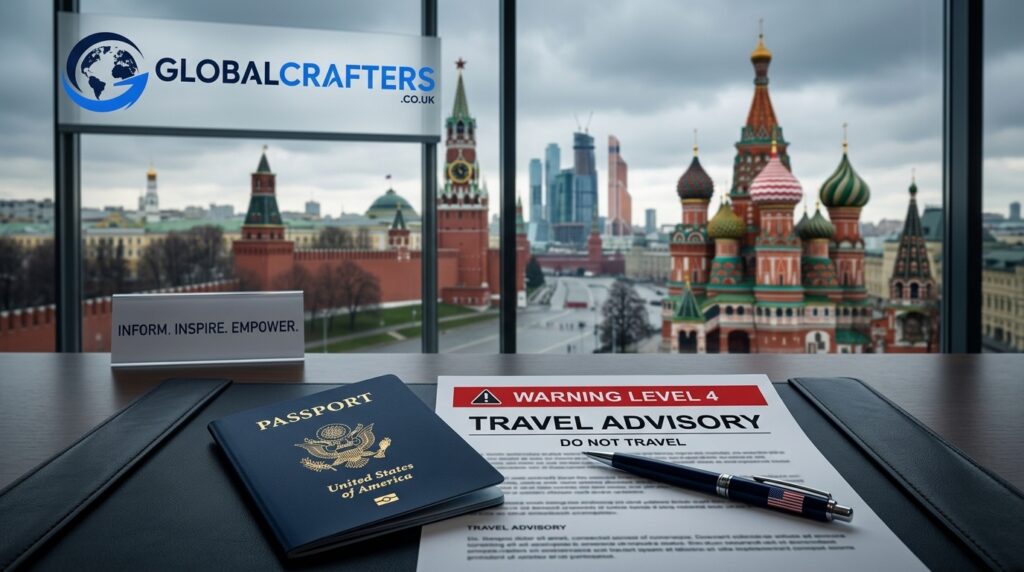

The U.S. government currently advises American citizens not to travel to Russia for any reason. The U.S. Department of State classifies Russia as Level 4: Do Not Travel, the highest level in its four tier travel advisory system. The current Russia advisory is dated December 29, 2025.
The advisory identifies several categories of concern, including terrorism, unrest, wrongful detention, and other risks. The State Department specifically warns about dangers connected with the continuing Russia Ukraine war, harassment or wrongful detention by Russian security officials, arbitrary enforcement of local laws, and the possibility of terrorism.
The warning is therefore broader than an ordinary recommendation to exercise additional caution. A Level 4 advisory means the U.S. government is advising American travelers against entering the country because the risks are considered sufficiently serious that travel should be avoided.
For people searching “US government advises citizens against all travel to Russia,” the key point is that this is not simply a social media rumor or a general geopolitical statement. It reflects the formal travel advisory published by the U.S. Department of State.
What the US Government Advises About Travel to Russia
The wording used by the State Department is direct: Americans should not travel to Russia for any reason. U.S. citizens who are already in Russia are advised to leave immediately.
The government also says its ability to assist U.S. citizens in Russia is limited, particularly outside Moscow. The U.S. Embassy in Moscow has reduced staffing, while Russian authorities have imposed restrictions affecting embassy personnel. The State Department also says U.S. consulates in Russia have suspended operations, including consular services.
This matters because travelers generally depend on their country’s diplomatic mission for emergency assistance when serious problems occur abroad. The State Department’s warning indicates that such assistance may be particularly difficult in Russia under current circumstances.
The advisory is intended specifically for U.S. citizens and nationals. It does not automatically constitute a legal prohibition preventing every American from entering Russia. Rather, it is a formal U.S. government warning strongly advising against travel.
Why the US Government Advises Against Travel to Russia
The reasons given by the State Department involve several different types of risk rather than one isolated incident. The continuing war between Russia and Ukraine contributes to the broader security environment, while the government also identifies detention, terrorism, unrest, and local law enforcement as concerns.
Another important consideration is the relationship between the United States and Russia. The State Department warns that Russian officials have questioned and threatened U.S. citizens without what the department considers adequate reason. It also reports cases involving arrests on what it describes as false charges and convictions without credible evidence.
The advisory also states that Russian authorities have opened questionable investigations involving the religious activities of U.S. citizens. These warnings demonstrate why the State Department’s advice extends beyond traditional tourist safety concerns.
For an American planning a vacation, business trip, family visit, study program, or other journey, the risks described by the government can affect the entire travel experience, including arrival, movement within the country, communication, finances, and access to consular assistance.
Russia Ukraine War and Travel Risks
The continuing war between Russia and Ukraine is one of the main factors cited by the U.S. government in its Russia travel advisory. The State Department warns of danger associated with the conflict and says travelers should avoid Russia for this reason as well as other security concerns.
The effects of the conflict are not necessarily limited to areas directly involved in fighting. The State Department reports drone attacks and explosions near the Ukrainian border and in cities including Moscow, Kazan, and St. Petersburg.
This means that travelers cannot assume that staying in a major Russian city completely eliminates security concerns. Large urban areas can still experience incidents connected with the broader conflict.
Travel conditions can also change quickly during an ongoing conflict. Transportation arrangements, air connections, security measures, border procedures, and local restrictions may be affected by developments that are difficult to predict in advance.
Risk of Wrongful Detention
Wrongful detention is one of the most prominent concerns in the U.S. government’s current Russia advisory. The State Department says the risk of wrongful detention of U.S. citizens remains high and warns that the Russian government may not grant U.S. Embassy consular access to detained Americans.
The advisory further states that U.S. citizens could potentially serve an entire prison sentence without release and that even when a case is determined to involve wrongful detention, there is no guarantee that the person will be released.
This creates an important distinction between ordinary travel problems and detention situations. A lost passport, minor accident, or medical emergency may normally be handled with assistance from a diplomatic mission. A detention case can involve legal proceedings under the host country’s system and may severely restrict the ability of U.S. officials to help.
The State Department therefore specifically warns Americans to avoid Russia because of the significant detention risk.
Terrorism and Security Threats
Terrorism is another risk category identified in the current Level 4 Russia advisory. The State Department notes that there have been terrorist incidents and security threats in Russia.
The advisory refers to the 2024 attack at Crocus City Hall near Moscow, for which ISIS Khorasan claimed responsibility. It also warns about drone attacks and explosions in different parts of the country.
For travelers, this means that conventional tourist planning cannot completely account for the security environment. Crowded public locations, transportation hubs, entertainment venues, and other public spaces can be affected by security incidents.
The government’s advice reflects an assessment of the overall environment rather than a statement that every location in Russia is experiencing an active attack. Travelers should distinguish between the existence of a national Level 4 advisory and claims that every Russian city is continuously unsafe.
Local Laws and Enforcement
Another major issue highlighted by the U.S. government is the enforcement of Russian laws. The State Department warns Americans about the arbitrary enforcement of local laws and says Russian authorities may question or threaten U.S. citizens.
The advisory also warns that Russia can monitor, seize, and search travelers’ phones. Americans may face fines or imprisonment over internet searches, online content, and social media posts that Russian authorities consider illegal.
This is particularly relevant for journalists, researchers, students, activists, business travelers, and people who regularly post political or sensitive material online. However, the warning is not limited to those groups. Ordinary travelers should also understand that laws and enforcement practices in another country can differ substantially from those in the United States.
The safest interpretation of the State Department’s guidance is that American visitors should not assume that activities permitted under U.S. law will necessarily receive the same treatment in Russia.
Limited US Government Assistance
The U.S. government’s ability to provide assistance is an important part of the current warning. The State Department says the U.S. Embassy in Moscow has reduced staffing and that Russia has restricted travel by embassy personnel.
The department also states that all U.S. consulates in Russia have suspended operations, including consular services. The country information page says consular services at locations including Yekaterinburg, St. Petersburg, and Vladivostok are suspended indefinitely, with travelers directed toward the Embassy in Moscow for consular matters.
For an American traveler, this can make routine administrative problems more complicated. Replacing documents, seeking assistance after detention, dealing with emergencies, or obtaining other consular help may be more difficult than in countries where U.S. diplomatic operations are functioning normally.
This limited capacity is one reason the State Department tells Americans already in Russia to leave immediately.
What US Citizens Already in Russia Should Know
The current State Department advice is that U.S. citizens already in Russia should leave immediately. The government says Americans should not remain in the country assuming that normal consular support will always be available.
The advisory specifically emphasizes that U.S. government assistance may be limited, particularly outside Moscow. This makes personal contingency planning important for anyone who is currently in Russia despite the travel warning.
Americans already in the country should monitor official U.S. government information and understand their available travel and communication options. They should also maintain access to important identification and travel documents and consider how they would respond if transportation or communication arrangements changed.
The situation is different for every traveler, so people already in Russia with complicated immigration, legal, family, employment, or other circumstances may need professional advice appropriate to their individual situation.
Can Americans Still Travel to Russia?
A U.S. government travel advisory is not necessarily the same thing as a U.S. law banning travel. The current State Department page describes Russia as Level 4 and says Americans should not travel there for any reason, but the advisory itself is presented as travel guidance rather than a general criminal prohibition on Americans entering Russia.
Travelers must also consider Russia’s own entry requirements, visa rules, border procedures, and immigration regulations. Meeting Russian entry requirements does not mean that the U.S. government considers the trip safe.
This distinction is important because someone may technically be able to arrange a trip while still receiving a strong warning from the U.S. government not to make that journey.
Anyone considering travel should check the latest official information immediately before making arrangements because travel advisories can change.
Practical Issues for Americans in Russia
Travelers also face practical financial and communication issues. The State Department says U.S. credit and bank cards cannot be used in Russia and warns that the U.S. Embassy cannot help travelers transfer funds to avoid sanctions.
This can create difficulties for tourists who expect to rely on American banking services during their trip. Financial preparation is therefore an important consideration for anyone who is already in Russia.
The State Department also warns about drug laws. It specifically states that drug use, possession, and importation are illegal and can carry severe punishments, including in relation to THC and CBD products.
Travelers should therefore avoid assuming that familiar products or behaviors will be treated in the same way as they are in the United States. Local laws apply while a person is in Russia.
What the Travel Warning Means for Tourists
For an American planning a vacation to Moscow, St. Petersburg, or another Russian destination, the most important message is that the State Department does not recommend proceeding with the trip.
The warning applies nationally rather than being limited to one tourist destination. The government’s stated concerns include terrorism, unrest, wrongful detention, arbitrary enforcement of local laws, and dangers associated with the Russia Ukraine war.
Tourists should also consider the practical consequences of traveling to a country where U.S. diplomatic assistance is limited. Even an ordinary emergency can become more difficult when consular operations are restricted.
People searching for “Russia travel advisory for Americans,” “Can Americans travel to Russia,” “Russia Level 4 travel advisory,” or “Is it safe for Americans to visit Russia” should therefore start with the official State Department advisory rather than relying only on travel blogs or social media posts.
What the Warning Means for Business Travelers
Business travel can involve additional complications because professional activities may bring travelers into contact with Russian organizations, government institutions, financial systems, or regulated industries.
The State Department’s warnings concerning local law enforcement and detention are relevant to business travelers just as they are to tourists. A business purpose does not remove the risks identified in the Level 4 advisory.
Companies sending employees to Russia should therefore review the current government advisory and consider their own corporate security procedures before authorizing travel.
Employers may also need to consider emergency communications, evacuation planning, insurance arrangements, financial access, legal support, and the limited availability of U.S. consular assistance.
Why Is the Russia Travel Advisory Trending?
The phrase “US government advises citizens against all travel to Russia” can attract significant search interest because travel advisories combine international politics with immediate practical questions about safety.
Searchers may encounter headlines, social media posts, or news reports discussing the advisory and then look for confirmation from an official source. The Department of State’s Russia page provides that confirmation: Russia remains at Level 4, Do Not Travel, with terrorism, unrest, wrongful detention, and other risks identified.
Interest can also increase when developments involving Russia, Ukraine, U.S. citizens, diplomatic relations, or security incidents appear in the news. However, a travel advisory should be interpreted according to the government’s published wording and date rather than according to an individual headline.
The current advisory was issued on December 29, 2025, and the State Department’s current travel advisory listing continues to show Russia at Level 4.
Is Russia Completely Off Limits to Americans?
The phrase “do not travel” should not be confused with a claim that every part of Russia experiences identical conditions at every moment.
The State Department’s position is that Americans should not travel to Russia because of the overall risks identified in the advisory. That is different from claiming that every Russian city or every traveler will experience a specific incident.
The advisory is a government risk assessment designed to help Americans make informed travel decisions. It identifies broad national concerns that include terrorism, unrest, detention, local law enforcement, and the ongoing war environment.
For Americans already living in Russia, the situation is more complicated because leaving may involve employment, family, property, immigration, or other considerations. The State Department nevertheless says U.S. citizens in Russia should leave immediately.
Conclusion
The US government advises citizens against all travel to Russia under the current Department of State travel advisory. Russia is listed at Level 4: Do Not Travel, with terrorism, unrest, wrongful detention, and other risks identified by the U.S. government.
The warning is particularly significant because the State Department says U.S. citizens in Russia face a high risk of wrongful detention and may have limited access to American consular assistance. The government also points to risks associated with the continuing Russia Ukraine war, terrorism, arbitrary enforcement of local laws, and security incidents.
You may also read more blogs
Frequently Asked Questions
Is Russia currently a Level 4 travel advisory?
Yes. The U.S. Department of State currently lists Russia at Level 4: Do Not Travel. The advisory was issued December 29, 2025.
Why does the US government say not to travel to Russia?
The State Department cites the continuing Russia Ukraine war, terrorism, unrest, wrongful detention, harassment by security officials, and arbitrary enforcement of local laws.
Can US citizens currently in Russia get help?
The U.S. government says its ability to assist Americans in Russia is limited, especially outside Moscow. U.S. consular operations in Russia have also been significantly restricted.
Should Americans already in Russia leave?
The State Department advises U.S. citizens already in Russia to leave immediately.
Is wrongful detention a concern for Americans in Russia?
Yes. Wrongful detention is specifically identified as a risk, and the State Department says the risk to U.S. citizens remains high.
Can Americans use US bank cards in Russia?
The State Department says U.S. credit and bank cards cannot be used in Russia.
Does the warning apply only to Moscow?
No. The Level 4 advisory applies to Russia generally. The State Department also reports security incidents in several cities and says its ability to assist Americans is particularly limited outside Moscow.
Where should travelers check for updates?
Travelers should check the official U.S. Department of State Russia Travel Advisory before making or changing travel plans. The advisory provides the government’s current risk assessment and travel guidance.