
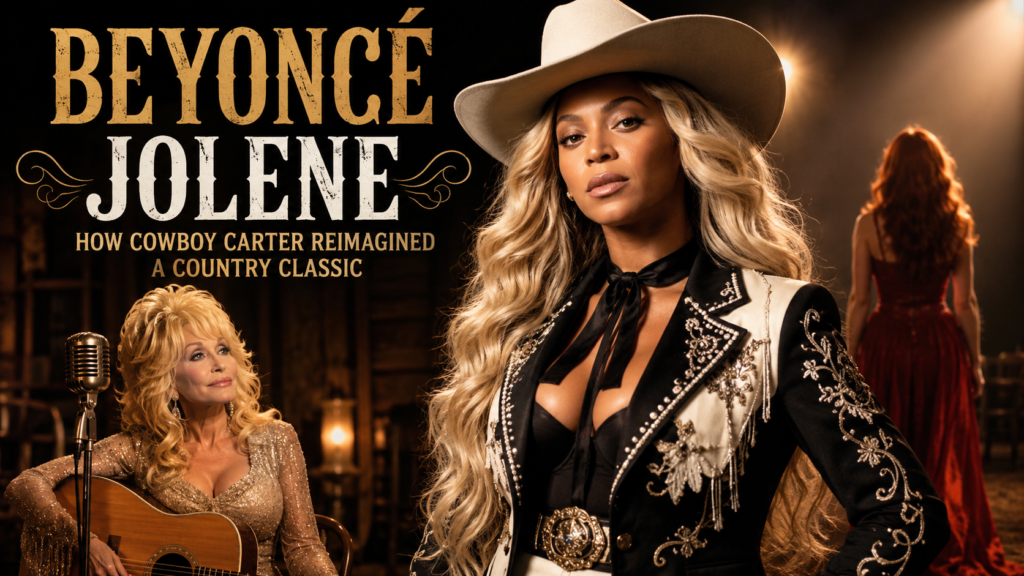

Beyoncé’s Jolene became one of the most discussed tracks on Cowboy Carter because it did something far more ambitious than simply repeat a famous country song. Instead of delivering a faithful cover of Dolly Parton’s original, Beyoncé rewrote much of its emotional perspective, transforming a vulnerable appeal into a firm confrontation.
That decision immediately divided listeners. Some praised the track as a confident, culturally significant reinterpretation that placed Beyoncé’s voice inside country music history. Others argued that replacing the original song’s insecurity with strength removed the emotional tension that made Dolly Parton’s recording so unforgettable. Both reactions reveal why Beyoncé Jolene remains such an interesting subject: it is simultaneously a tribute, a revision and a debate about how classic songs can evolve.
What Is Beyoncé Jolene?
Beyoncé’s Jolene is a reimagined version of the country song written and originally recorded by Dolly Parton. It appears on Beyoncé’s eighth studio album, Cowboy Carter, which was released on March 29, 2024. The album’s official track listing places Jolene directly after the spoken interlude Dolly P, creating a deliberate introduction from Parton before Beyoncé takes control of the story.
Although the familiar title, central character and recognizable melodic foundation remain, Beyoncé changes much of the narrative. Dolly Parton is still officially credited as the songwriter, while Beyoncé performs a version containing substantial lyrical and structural differences. This makes the track closer to a creative reinterpretation than a conventional cover.
Where the Song Appears on Cowboy Carter
Jolene is positioned near the first half of Cowboy Carter, following songs such as Texas Hold ’Em and Bodyguard. Its placement is important because the album is structured like a wide ranging American radio experience, with spoken appearances from country figures including Dolly Parton and Willie Nelson connecting different musical sections.
The short Dolly P introduction also links Jolene to Beyoncé’s earlier work. Parton refers indirectly to the mysterious romantic rival mentioned on Beyoncé’s Lemonade album, connecting an established country character with Beyoncé’s own storytelling about betrayal, marriage and reconciliation. The result is a conversation between two musical eras rather than a stand alone remake.
More Than a Traditional Cover
A traditional cover usually preserves most of the original lyrics and emotional meaning while changing the singer, arrangement or performance style. Beyoncé’s Jolene takes a different path. She retains the central idea of a woman addressing a potential romantic rival but changes the speaker’s attitude, reasoning and sense of authority.
That difference explains why many listeners call it a reimagining. Dolly Parton’s recording is driven by fear that another woman may be able to take away the person she loves. Beyoncé’s narrator believes her relationship and family have already been tested, built and defended. She is not requesting mercy; she is establishing a boundary.
Who Is Jolene in Beyoncé’s Version?
Jolene is the woman addressed by the narrator, but she is not necessarily meant to represent one publicly identifiable person. In both versions, the character functions as a symbol of beauty, temptation, jealousy and the possibility that a relationship could be threatened by an outsider.
Dolly Parton has explained that the original idea was partly inspired by a red haired bank employee who attracted her husband’s attention. She also took the name “Jolene” from a young fan she met. The resulting character became larger than either real life influence and developed into one of country music’s most recognizable figures. Parton first released the song as a single in 1973 before including it on her 1974 album of the same name.
A Character Rather Than a Confirmed Real Person
In Beyoncé’s interpretation, Jolene works best as an archetype rather than a confirmed individual. She represents anyone who might knowingly interfere in an established relationship. The lyrics focus less on describing her physical appearance and more on rejecting the threat she supposedly presents.
This distinction matters because some listeners immediately connected the song to speculation about Beyoncé and JayZ’s marriage. While the track can reasonably be understood through themes previously explored on Lemonade, Beyoncé has not publicly confirmed that her version of Jolene is a direct portrait of one specific person. Treating the song as autobiography alone can therefore narrow its broader meaning.
The Connection to Lemonade
The Dolly P interlude intentionally recalls the relationship narrative associated with Lemonade. On that album, Beyoncé explored anger, infidelity, emotional pain, forgiveness and the complicated work of preserving a marriage. Dolly Parton’s introduction connects those subjects to the romantic anxiety at the heart of the original Jolene.
However, the emotional position has changed. Lemonade often documented the shock and damage caused by betrayal. Beyoncés Jolene sounds like it comes from someone who has already survived that crisis. The narrator is no longer discovering how vulnerable her relationship may be; she is declaring what she has built and what she refuses to lose.
How Beyoncé Changes the Meaning of Jolene
The clearest difference between the recordings is the balance of power. Dolly Parton’s narrator admits that Jolene possesses extraordinary beauty and appears frightened that she cannot compete. Her honesty makes the song emotionally exposed. She places the outcome in Jolene’s hands and hopes the other woman will choose compassion.
Beyoncé’s narrator refuses to surrender that control. She acknowledges the potential rival but does not treat her as superior. The message becomes a warning that beauty and attention are not enough to destroy a marriage, family or shared history. This change turns the song from an intimate plea into a declaration of confidence.
From Vulnerability to Confrontation
The vulnerability of Dolly Parton’s original is central to its lasting impact. The narrator does not attack Jolene or pretend to feel secure. She admits fear, admiration and dependence, creating a complicated emotional portrait in which jealousy and respect exist at the same time.
Beyoncé replaces much of that uncertainty with confrontation. Her delivery communicates authority and emotional preparedness. For supporters of the remake, this is empowering because the woman speaking refuses to diminish herself. For critics, the confidence makes the situation less dramatic because the narrator never appears genuinely at risk.
Marriage, Family and Shared History
Beyoncé’s version repeatedly emphasizes the strength of an established partnership. The narrator’s argument is not merely that she loves her husband; it is that the couple has created a family and endured experiences that an outsider cannot easily replace.
This focus makes the song less about competition between two women and more about protecting a long term commitment. At the same time, some listeners questioned why the rival receives such a forceful warning when responsibility for fidelity also belongs to the partner. That criticism became an important part of the online conversation surrounding the track.
How Beyoncé’s Jolene Sounds
Musically, Beyoncé keeps enough of the original identity for the song to remain immediately recognizable. The repeated name, familiar melodic movement and country foundation preserve its connection to Dolly Parton’s composition. The production, however, is fuller and more contemporary, combining guitar based country elements with rhythmic textures associated with Beyoncé’s pop and R&B work.
Her vocals are controlled, layered and commanding. Rather than imitate Parton’s lighter, more fragile performance, Beyoncé uses a lower and firmer delivery. Background voices and expanded harmonies help the recording feel communal and dramatic, especially as it develops beyond the simpler structure of the original.
The arrangement also fits the broader purpose of Cowboy Carter. The album does not attempt to reproduce one narrow form of traditional country music. It combines country, folk, gospel, rock, blues, pop, R&B and other American styles, presenting genre as a connected history rather than a set of rigid boundaries. Critics including Pitchfork described the album as ambitious and shaped around Beyoncé’s singular artistic identity.
Why Is Beyoncé Jolene Trending?
The track began trending immediately after Cowboy Carter arrived because audiences already knew the original song extremely well. Jolene is one of Dolly Parton’s signature recordings and has been covered by numerous performers across different styles. Any Beyoncé version would have attracted attention, but the rewritten story made the release especially newsworthy.
The song also appeared during a much larger conversation about Beyoncé’s relationship with country music. Cowboy Carter debuted at number one on the Billboard 200 and Top Country Albums chart, making Beyoncé the first Black woman to reach number one on the latter chart. Her Jolene also debuted within the top ten of the Billboard Hot 100 and reached number ten on the United Kingdom’s official singles chart.
Social media amplified the discussion by encouraging instant comparisons between the two versions. Fans debated which narrator appeared stronger, whether vulnerability should be considered weakness, and whether Beyoncé’s version was truly a cover. The song became a useful test of how different generations interpret love, jealousy and female power.
Beyoncé Jolene Reviews and Public Reaction
Reviews of Beyoncé’s Jolene were notably mixed, even among critics who admired Cowboy Carter as a whole. Positive responses emphasized the boldness of transforming a song so closely associated with another artist. Supporters argued that Beyoncé respected the original precisely by refusing to imitate it.
More critical reactions focused on the emotional rewrite. Some listeners believed the warning-based approach reduced the complexity of the original narrator, whose fear and admiration make her unusually human. Singer Lily Allen was among the public figures who expressed dislike for the cover, while other commentators defended Beyoncé’s right to reinterpret the story in a way that reflected her own persona.
What Supporters Liked
Supporters praised Beyoncé for making an extremely familiar composition feel newly relevant. The changed point of view creates a conversation between two women who respond differently to the same perceived threat. One feels exposed and asks for sympathy; the other feels prepared and announces consequences.
Fans also appreciated Dolly Parton’s direct participation. By introducing the song herself, Parton effectively welcomes Beyoncé into the Jolene tradition. This reduces the sense that the original has been replaced. Instead, the album presents the new recording as another chapter in the character’s cultural life.
What Critics Disliked
The most common criticism was that the remake exchanges emotional complexity for certainty. The original is haunting because its narrator recognizes Jolene’s power and cannot guarantee that love will protect her. Beyoncé’s narrator sounds so confident that the rival appears unlikely to succeed, reducing the suspense.
Other critics disliked the confrontational framing between women. They felt the partner’s responsibility deserved more attention than the outsider’s behavior. These objections do not necessarily make the remake unsuccessful, but they demonstrate how a changed perspective can alter the moral and emotional center of a famous song.
What Did Dolly Parton Say About Beyoncé’s Jolene?
Dolly Parton publicly supported Beyoncé’s recording. She explained that she had expected a more conventional cover and was surprised by how extensively Beyoncé changed it. Nevertheless, she described the approach as bold and said she loved that Beyoncé made the song her own.
Parton’s approval is particularly important because she remains the credited songwriter. Her appearance on Dolly P also shows that the connection was collaborative rather than accidental. In a later 2025 interview, Parton again praised Cowboy Carter and expressed pride in Beyoncé’s distinctive interpretation.
Her response reflects a generous understanding of cover songs. Rather than requiring every performer to preserve the original emotion, Parton has historically welcomed different arrangements and styles. Jolene has survived partly because new singers repeatedly discover fresh meanings inside its simple dramatic premise.
Latest Update on Beyoncé Jolene
The most significant later development was the continued recognition of Cowboy Carter. At the 2025 Grammy Awards, the project won Album of the Year and Best Country Album, while II Most Wanted, Beyoncé’s collaboration with Miley Cyrus, won Best Country Duo/Group Performance. The Album of the Year victory was Beyoncé’s first in that category.
Jolene itself was not the album’s main award winning single, but it remained one of its most culturally visible tracks. Its chart debut, high profile authorship and intense critical discussion ensured that it continued to represent the album’s larger interest in revisiting American musical history.
Dolly Parton’s continued praise also helped settle questions about whether she approved of the extensive rewrite. Her comments made clear that she regarded Beyoncé’s interpretation as an imaginative extension of the song rather than a disrespectful replacement.
Why Beyoncé’s Jolene Matters
Beyoncé’s Jolene matters because it demonstrates that a cover does not have to function as imitation. A performer can preserve a song’s recognizable foundation while challenging its assumptions. Beyoncé keeps the rival, the relationship and the central conflict, but changes what the woman speaking believes about herself.
The track also highlights how ideas about empowerment can differ. Dolly Parton’s narrator is vulnerable, but vulnerability does not necessarily make her weak. She is brave enough to admit fear directly. Beyoncé’s narrator is assertive, but assertiveness does not automatically resolve the deeper questions about trust and responsibility.
Together, the recordings create a richer cultural conversation than either would produce alone. The original captures the terror of feeling replaceable. The reimagining captures the determination of someone who refuses to be displaced. Listeners may prefer one perspective, but the contrast gives “Jolene” another reason to remain relevant across generations.
Conclusion
Beyoncé’s Jolene succeeds as a conversation provoking reinterpretation, even for listeners who prefer Dolly Parton’s original. It transforms a fearful request into a confident warning and shifts the focus from a rival’s beauty to the strength of an established relationship.
Frequently Asked Questions About Beyoncé Jolene
Is Beyoncé’s Jolene a Cover of Dolly Parton’s Song?
Yes, it is based on Dolly Parton’s Jolene and retains the original title, central character and recognizable musical foundation. Parton remains credited as the songwriter.
When Did Beyoncé Release Jolene?
Beyoncé released Jolene as part of Cowboy Carter on March 29, 2024. The song was available with the full album rather than being introduced as one of its initial lead singles.
Did Beyoncé Change the Jolene Lyrics?
Yes. Beyoncé changed large sections of the song’s wording and emotional perspective. Her narrator warns the rival rather than asking her to show mercy.
Because song lyrics are copyrighted, the full rewritten text should be viewed through an authorized lyrics provider or Beyoncé’s official album website.
Why Did Beyoncé Rewrite Jolene?
Beyoncé has not provided a detailed line by line public explanation of every change. Artistically, the rewrite allows the song to reflect a more confident narrator and connect with themes of marriage, betrayal and survival explored in her previous work.
It also prevents the recording from becoming a simple imitation of Dolly Parton’s performance. Beyoncé creates a version that matches her vocal identity and the wider narrative of Cowboy Carter.
Did Dolly Parton Approve Beyoncé’s Version?
Yes. Parton said she was initially surprised because she expected Beyoncé to sing the familiar version. She nevertheless praised the result as bold and expressed appreciation for Beyoncé’s personal interpretation.
Parton also appears on Cowboy Carter, introducing Jolene through the Dolly P interlude and contributing another spoken appearance later in the album.
Is Beyoncé’s Jolene About Jay-Z?
Many listeners interpret the song through the history explored on Lemonade, particularly because Dolly P directly references that album’s romantic rival narrative.
However, Beyoncé has not officially identified Jolene as one specific real person. The safest interpretation is that the character represents a perceived threat to an established relationship.
Which Version of Jolene Is Better?
The answer depends on what a listener values. Dolly Parton’s original offers vulnerability, melodic simplicity and emotional suspense. Beyoncé’s version offers power, expanded production and a more confrontational perspective.
Rather than cancelling each other out, the recordings can be heard as two different responses to jealousy. One asks for compassion; the other establishes a boundary.
How Successful Was Beyoncé’s Jolene?
The song debuted at number seven on the Billboard Hot 100 and reached the top ten on several other charts, including a number ten peak on the United Kingdom’s main singles chart.
Its parent album achieved even greater commercial and awards success, topping major album charts and later winning Album of the Year and Best Country Album at the 2025 Grammys.
You may also read more blogs