
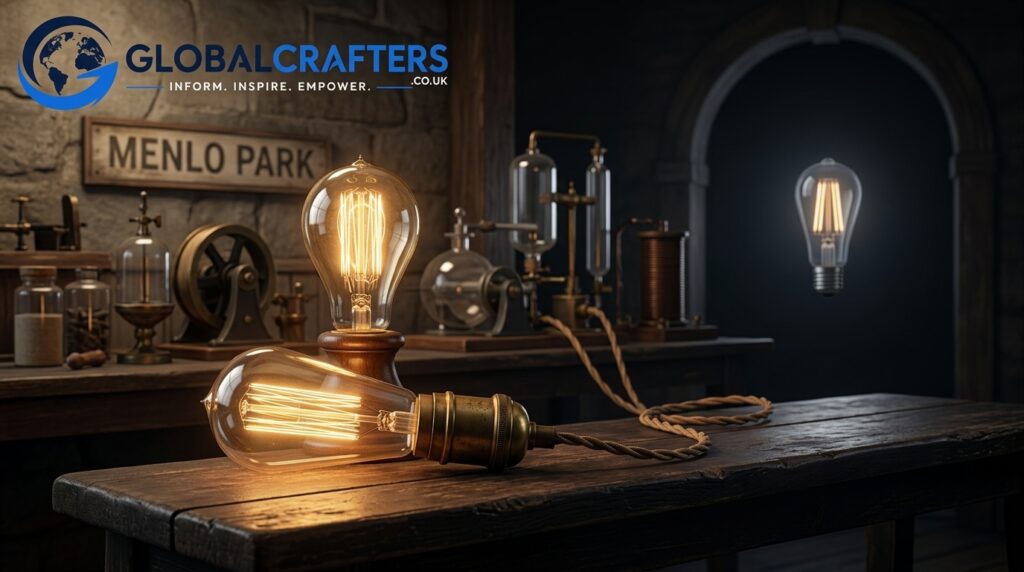

The question when was the light bulb invented? has a more complicated answer than many people expect because the modern light bulb was not created by one person on one particular day. Several inventors and scientists worked on electric lighting throughout the 19th century, gradually solving problems involving electrical current, filaments, glass bulbs, vacuum technology, and power distribution. However, Thomas Edison is generally credited with developing the first practical and commercially viable incandescent light bulb in 1879, building on decades of experiments by earlier inventors. The U.S. Department of Energy explains that electric light research had been underway for many years before Edison, while the Library of Congress describes Edison’s 1879 incandescent lamp as the first long lasting design suitable for widespread practical use. Edison and his team conducted extensive experiments at the Menlo Park laboratory in New Jersey, eventually developing a carbon filament lamp that could remain illuminated for a useful period of time. His public demonstration on December 31, 1879, became one of the most famous moments in the history of electric lighting.
The commonly repeated date of October 21, 1879 is often described as the date Edison invented the light bulb, but the historical record is more nuanced. Edison’s laboratory notebooks show that he was conducting a continuing series of experiments rather than suddenly creating a finished commercial bulb on a single day. The Smithsonian notes that the mythology surrounding October 21 has simplified a much longer development process. Experiments with carbonized cotton thread around October 22 produced a lamp that operated for approximately 14.5 hours, while later improvements produced much longer lasting lamps. Therefore, if someone asks when the light bulb was invented, the simplest accurate answer is 1879 for Edison’s practical incandescent lamp, while the broader history of electric lighting stretches back several decades earlier.
Who Invented the Light Bulb?
Thomas Edison is the name most closely associated with the invention of the light bulb, but saying that Edison invented electric light completely from scratch would not accurately describe the history. Before Edison began his famous experiments, other inventors had already demonstrated that electricity could produce light. Early electric lighting experiments included arc lamps and other forms of electric illumination. The U.S. Department of Energy states that the first constant electric light was demonstrated in 1835 and that researchers continued working on incandescent lamps for roughly the next four decades. These early attempts were important because they established the basic principle that electrical energy could be converted into visible light, but the technology was generally unsuitable for ordinary homes because early lamps could be inefficient, expensive, difficult to control, or unable to operate for long periods.
The real challenge was not simply producing light with electricity. Inventors needed to create a lamp that could operate reliably, last for a reasonable amount of time, consume an acceptable amount of electricity, and work as part of a larger electrical distribution system. Edison approached the problem as a complete system rather than merely as an isolated bulb. His work included the lamp itself, generators, wiring, switches, sockets, meters, and the infrastructure needed to deliver electricity to customers. This broader approach was one of the reasons his lighting technology became commercially significant. The Smithsonian explains that Edison’s important contribution was developing a practical high resistance filament and integrating the lamp into a larger electric lighting system.
The History of Electric Lighting Before Edison
Long before incandescent bulbs became common, people relied on candles, oil lamps, gas lighting, and other forms of artificial illumination. Gas lighting became increasingly important during the 19th century, particularly in cities, streets, businesses, and public buildings. However, gas lighting had disadvantages, including open flames, heat, maintenance requirements, and safety concerns. Inventors therefore looked for ways to use electricity to create a cleaner and more controllable source of illumination.
Arc lighting was among the important early forms of electric lighting. Unlike the incandescent bulb, which produces light by heating a filament inside a sealed glass envelope, an arc lamp produces light through an electrical arc between electrodes. Early electric arc lights could be extremely bright, making them useful for streets and large public spaces, but they were generally unsuitable for ordinary household lighting because of their intensity and operating requirements. Researchers therefore continued searching for a smaller electric lamp that could provide steady illumination inside homes and businesses.
During the middle decades of the 19th century, inventors experimented with incandescent lighting. The basic idea was relatively simple: pass electrical current through a material until it becomes hot enough to glow. The difficult part was finding a material that could become extremely hot without quickly burning away or breaking. Oxygen was another major problem because a hot filament exposed to air would oxidize and deteriorate rapidly. The solution required placing the filament inside a glass enclosure and removing as much air as possible. Better vacuum pumps eventually made this approach increasingly practical.
Joseph Swan and the Development of the Light Bulb
One of the most important figures in the history of the light bulb was British inventor Joseph Wilson Swan. Swan began experimenting with carbon filaments during the 1850s and 1860s, although his early work was limited by the vacuum technology available at the time. As better vacuum pumps became available during the 1870s, Swan returned to incandescent lighting research and achieved significant progress.
According to the Smithsonian’s National Museum of American History, Swan reported success by late 1878 and demonstrated a working lamp during a lecture in Newcastle in February 1879. His lamp contained several features that would become central to practical incandescent lighting, including an enclosed glass bulb, platinum lead wires, and a carbon light emitting element. Swan’s work demonstrates why the history of the light bulb cannot fairly be reduced to one inventor. Several researchers were working toward similar solutions at approximately the same time, and each contributed important ideas and improvements.
Swan’s early lamp, however, had limitations. His carbon rod had relatively low electrical resistance, which meant that the lamp required substantial current and was difficult to use efficiently with long electrical wires. Edison recognized that a much thinner, higher resistance filament could make electric lighting more practical because it would require less current and could work with longer distribution wires. This difference was crucial to Edison’s approach and helped his lighting system become commercially useful.
Thomas Edison’s Breakthrough in 1879
Thomas Edison began concentrating heavily on electric lighting in 1878. His goal was not merely to make a bulb glow but to develop an entire electrical lighting system that could compete with established gas lighting. Edison and his research team worked at Menlo Park, New Jersey, conducting extensive experiments with different filament materials and lamp designs.
Finding the right filament was one of the biggest challenges. Edison’s researchers tested numerous materials, including carbon, platinum, cotton thread, paper, wood, and other substances. The goal was to find a filament that had suitable electrical resistance, could survive extremely high temperatures, and would remain stable inside the bulb. The Library of Congress notes that Edison tested thousands of materials before carbonized thread became a key part of the successful design.
By October 1879, Edison’s team had made significant progress. The Department of Energy reports that a carbonized uncoated cotton thread filament produced by Edison’s team lasted about 14.5 hours, demonstrating that the researchers were moving toward a practical solution. Continued experiments eventually produced improved filaments with substantially longer lifespans.
Edison’s achievement was therefore not simply creating a glowing filament. His major breakthrough was making incandescent lighting practical enough for widespread use. The lamp needed to work as part of a system in which electricity could be generated centrally and distributed through wires to individual consumers. This combination of bulb technology and electrical infrastructure transformed the invention from a laboratory experiment into a potentially commercial product.
What Happened on December 31, 1879?
One of the most important dates in light bulb history is December 31, 1879. On New Year’s Eve, Edison publicly demonstrated his electric lighting system at Menlo Park. Visitors traveled to the laboratory to see buildings and surrounding areas illuminated by electric lamps. The Smithsonian records that the demonstration involved approximately 70 lamps and became an important public introduction of Edison’s lighting system.
The event generated enormous public interest. Electric lighting appeared to offer a new alternative to traditional gas illumination, and the demonstration helped convince investors, journalists, and the public that electric lighting could become an important technology. Edison understood that an invention needed more than technical functionality; it also needed an economic and infrastructure system that could support widespread adoption.
The lamps demonstrated at Menlo Park were still undergoing improvement. The particular demonstration lamp described by the Smithsonian used a Bristol board filament and could operate for approximately 125 hours, while improved bamboo filament lamps introduced soon afterward could operate for approximately 600 hours. This illustrates how the invention continued evolving even after the famous 1879 demonstration.
When Did Edison Patent the Light Bulb?
Edison filed his U.S. patent application for his incandescent lamp on November 4, 1879, and the patent was granted on January 27, 1880. The patent was U.S. Patent No. 223,898 and described an improvement in electric lamps and their manufacturing.
The patent is important because it shows that Edison’s work was focused on producing a high resistance electric lamp suitable for practical electrical distribution. Rather than simply claiming the general idea of producing light with electricity, Edison’s patent addressed specific improvements that made incandescent lighting more useful.
It is also worth remembering that patent dates and invention dates are not always the same thing. Edison had already been experimenting with electric lighting before filing the patent, and his public demonstration occurred later in December 1879. This is why different historical sources may give different dates when discussing when the light bulb was invented. 1879 marks the major breakthrough and public demonstration, while January 1880 marks the granting of Edison’s important U.S. incandescent lamp patent.
How Did the First Light Bulb Work?
The basic principle behind an incandescent light bulb is straightforward. Electricity passes through a filament that has electrical resistance. As current flows through the filament, electrical energy is converted into heat. When the filament becomes hot enough, it begins to glow and emit visible light.
The filament must be protected from oxygen because a very hot material would otherwise oxidize and burn rapidly. Early incandescent bulbs therefore placed the filament inside a glass bulb from which air had been removed. Later incandescent bulbs commonly used inert gases to reduce filament evaporation and oxidation. The U.S. Department of Energy explains that the atmosphere inside the bulb became an important part of improving incandescent lamp performance.
Edison’s high resistance filament was especially important because it allowed the lighting system to distribute electrical power more effectively. Instead of requiring enormous currents through short wires, a high resistance filament allowed lamps to operate using a more practical electrical distribution arrangement. This helped Edison connect the light bulb with the larger challenge of bringing electricity into homes and businesses.
Why Was Edison’s Light Bulb So Important?
The importance of Edison’s light bulb goes far beyond replacing candles or gas lamps. Reliable electric lighting helped accelerate the development of electrical infrastructure and changed how people used homes, offices, factories, streets, and public buildings. Electric lighting could be switched on and off quickly, did not require an open flame, and could be distributed through electrical networks.
Edison understood that the bulb could not succeed commercially without an electrical supply system. His work therefore included generators, wiring, meters, switches, sockets, and other components. In 1882, his Pearl Street Station in lower Manhattan began providing electricity to customers, helping demonstrate how central power generation and electric lighting could work together. The Library of Congress identifies the Pearl Street system as the first commercial electric light system installed to prove the viability of Edison’s approach.
This development helped begin a much broader transformation. Once electrical networks were established, electricity could be used not only for lighting but also for appliances, motors, communication technologies, industrial equipment, and countless other applications. In this sense, the practical incandescent light bulb became one of the technologies that helped accelerate electrification.
How Did the Light Bulb Improve After 1879?
The light bulb continued changing rapidly after Edison’s breakthrough. One major development was the improvement of filament materials. Edison initially used carbon based filaments, including bamboo in some commercial lamps. According to the Department of Energy, bamboo filaments eventually provided lifetimes of up to approximately 1,200 hours and became a standard feature of Edison lamps for years.
Another major improvement was the development of metal filaments. European inventors introduced tungsten filament technology in the early 20th century. Tungsten could operate at very high temperatures and produced brighter light with longer service life than earlier carbon filaments.
In 1913, Irving Langmuir further improved incandescent lamps by introducing inert gas into the bulb. The Department of Energy reports that using an inert gas such as nitrogen approximately doubled the efficiency of the lamp. These advances transformed the original carbon filament concept into the familiar incandescent bulbs that remained common for much of the 20th century.
From Incandescent Bulbs to LED Lights
The history of the light bulb did not end with Edison. During the 20th century, other lighting technologies became increasingly important, including fluorescent lamps, halogen lamps, compact fluorescent lamps, and eventually light emitting diodes, commonly known as LEDs.
LED technology represents a major departure from incandescent lighting. An incandescent bulb produces light primarily by heating a filament until it glows, while an LED produces light through semiconductor technology. LEDs can provide high efficiency, long operating lifetimes, and lower energy consumption compared with traditional incandescent bulbs.
The modern lighting market therefore represents more than 150 years of continuous development. The basic idea of electric illumination evolved from early experiments and demonstrations into incandescent lamps, then into increasingly efficient technologies. Today, LEDs are widely used in homes, offices, vehicles, street lighting, displays, electronics, and industrial applications.
Was Thomas Edison Really the First Person to Invent the Light Bulb?
The most accurate answer is no, not in the sense that Edison was the first person ever to produce electric light. Several inventors experimented with incandescent lamps and other forms of electric lighting before Edison. Joseph Swan, for example, demonstrated a working incandescent lamp in Britain in early 1879, and other inventors had been experimenting with electric lighting for decades.
However, Edison deserves his famous place in light bulb history because he developed a practical high resistance incandescent lamp and, importantly, worked on the complete electrical system required to make electric lighting commercially useful. The Library of Congress specifically describes Edison’s 1879 lamp as the first incandescent lamp that was long lasting enough for widespread practical use.
Swan also played a significant role in the development of practical incandescent lighting. Eventually, the Edison and Swan interests were combined in Britain, creating the Edison & Swan United Electric Light Company, commonly known as Ediswan, in 1883. The history therefore reflects a broader pattern in technological development: major inventions often emerge from the combined efforts of many researchers rather than from one isolated moment.
When Did the Light Bulb Become Commercially Available?
After Edison’s public demonstration in 1879, development quickly moved toward commercial production. Edison’s improved lamps used better filament materials and became increasingly durable. The early 1880s were particularly important because electric lighting began moving from demonstrations and experimental laboratories into commercial environments.
The establishment of electric generating stations was essential to this process. A light bulb is useful only when electricity can reach it reliably. Edison therefore worked on the entire electrical supply chain, including power generation and distribution. His Pearl Street Station began operating in 1882 and represented an important step toward commercial electric power.
As electrical networks expanded, more homes, businesses, factories, and public buildings gained access to electric lighting. This expansion gradually changed everyday life and helped establish electricity as an essential part of modern society.
Why Is the Light Bulb Considered One of the Most Important Inventions?
The light bulb is often regarded as one of the most influential inventions because it changed the relationship between people and artificial light. Before widespread electric lighting, extending productive activity after sunset depended heavily on candles, oil lamps, gas lighting, and other technologies. Electric lighting provided a more convenient, controllable, and scalable alternative.
The broader impact was even greater because electric lighting encouraged the construction of power generation and distribution networks. Once those networks existed, they could support many other technologies. The Department of Energy notes that the development of electric lighting helped stimulate advances in power plants, electric transmission, home appliances, and electric motors.
Electric lighting also influenced architecture, urban planning, manufacturing, entertainment, transportation, and working patterns. Stores could remain open later, factories could operate more effectively after dark, streets could be illuminated, and homes could have dependable artificial lighting at the simple turn of a switch.
Conclusion
So, when was the light bulb invented? The best short answer is 1879, when Thomas Edison and his team developed a practical incandescent electric lamp and demonstrated the technology publicly at Menlo Park. However, the complete history is much richer than the familiar Edison story. Electric lighting had been studied for decades, Joseph Swan and other inventors made significant contributions, and numerous technical improvements were necessary before the light bulb could become a practical everyday technology.
Edison’s greatest contribution was not simply making a filament glow. He helped turn incandescent lighting into a practical system by improving the high resistance filament, developing reliable lamp components, and designing the electrical infrastructure needed to distribute power. His New Year’s Eve demonstration in 1879 and the commercial development that followed helped accelerate the transition from gas and flame based illumination toward electric lighting.
You may also read more blogs
Frequently Asked Questions About the Light Bulb
When was the light bulb invented?
The most commonly accepted answer is 1879, when Thomas Edison and his Menlo Park team developed a practical incandescent lamp. Edison publicly demonstrated his lighting system on December 31, 1879.
Who invented the light bulb?
Thomas Edison is generally credited with inventing the first practical and commercially viable incandescent light bulb, but other inventors, particularly Joseph Swan, made important contributions to incandescent lighting before and around the same period.
Did Edison invent the first electric light?
No. Electric lighting existed before Edison. Early arc lighting and incandescent experiments had already been demonstrated during the 19th century. Edison’s major achievement was developing a practical incandescent lamp and an integrated electrical lighting system suitable for widespread use.
When did Edison patent the light bulb?
Edison filed his incandescent amp patent application on November 4, 1879, and the U.S. patent was granted on January 27, 1880.
What filament did Edison use?
Edison experimented with many filament materials. His early successful lamps used carbonized materials, and later commercial Edison lamps famously used bamboo filaments.
When was the first public demonstration of Edison’s light bulb?
Edison publicly demonstrated his electric lighting system at Menlo Park on New Year’s Eve, December 31, 1879.