

The camera has become one of the most important technologies in modern life. People use cameras every day to capture family memories, document events, create professional photographs, produce films, communicate on social media, and record important moments. But the modern camera did not appear suddenly. It developed through centuries of experiments involving light, optics, chemistry, lenses, and image making.
So, when was the camera invented? There is no single date that completely answers the question because the camera evolved in stages. The basic optical principle behind the camera goes back many centuries through the camera obscura, while the first permanent photograph made using a camera is generally associated with French inventor Joseph Nicéphore Niépce in 1826 or 1827.
Niépce used a camera obscura and a light sensitive material to create what is regarded as the earliest surviving permanent camera photograph. His achievement became the foundation for the development of practical photography.
The year 1839 is also extremely important because Louis Daguerre’s daguerreotype process was publicly announced and became one of the first commercially practical photographic processes.
Understanding the history of the camera therefore requires looking at several major milestones rather than focusing on one invention date.
The Camera Obscura Came Before the Modern Camera
Long before people could take photographs, they understood a basic principle of optics: light entering a dark space through a small opening can project an image of the outside world onto an opposite surface.
This principle eventually became known as the camera obscura, which means “dark chamber.” It was essentially an optical device rather than a photographic camera because it could project an image but could not automatically preserve that image.
Historical evidence shows that the principle of the camera obscura was understood centuries before photography. Artists later used camera obscura devices to help them reproduce landscapes, buildings, and other subjects with greater accuracy. The Library of Congress describes how artists used early camera obscura devices to project scenes and trace the resulting images.
The camera obscura was therefore an essential technological ancestor of today’s camera.
A modern camera still relies on the same fundamental concept: light travels through an opening or lens and forms an image on a light sensitive surface. The major difference is that modern cameras use sophisticated sensors or photographic film to record that image.
Who Invented the Camera?
The answer depends on what we mean by “camera.”
If we are talking about the camera obscura, it cannot easily be credited to one individual because the optical principle was known and developed over a very long period.
If we mean the first person to successfully create a permanent photograph from an image projected by a camera, Joseph Nicéphore Niépce is one of the most important names in camera history.
Niépce was a French inventor who spent years experimenting with ways to permanently record images produced by light. By the 1820s, he had developed a process he called heliography, meaning roughly sun drawing.
His experiments eventually resulted in the famous photograph known as View from the Window at Le Gras. The image was created using a camera obscura and a plate coated with a light sensitive material. The surviving photograph is generally dated to 1826 or 1827.
For this reason, Niépce is widely recognized as a pioneer of photography and a key figure in the invention of the photographic camera.
The First Permanent Photograph
The most important milestone in early camera history occurred around 1826–1827, when Niépce succeeded in creating a permanent camera image.
He used a camera obscura to project the view outside his window onto a prepared plate. The plate was coated with bitumen of Judea, a light sensitive substance. When exposed to light, some areas hardened while other areas remained soluble.
The exposure was extremely long by modern standards. Sources describe the exposure as lasting several hours, with some historical accounts indicating approximately eight hours.
The resulting image showed buildings and parts of the surrounding landscape.
Today, this photograph is known as View from the Window at Le Gras and is held by the Harry Ransom Center at the University of Texas at Austin. The University describes it as the earliest surviving photograph produced with the aid of a camera obscura.
This was an extraordinary achievement because, for the first time, light itself could create and preserve a recognizable image without an artist manually drawing the scene.
Why Niépce’s Camera Was So Important
Niépce’s achievement changed the possibilities of visual communication.
Before photography, accurately recording a real world scene required an artist, painter, or illustrator. A camera obscura could help an artist see and trace an image, but the device itself did not preserve the scene.
Niépce’s process changed this relationship between light and image making.
Instead of simply projecting an image, the system could record the image onto a prepared surface. Although the process was slow and technically difficult, the basic concept represented the beginning of photography.
The camera could now become a recording device rather than simply an optical drawing aid.
This principle eventually led to portrait photography, journalism, scientific photography, filmmaking, medical imaging, aerial photography, digital photography, and smartphone cameras.
The Partnership Between Niépce and Daguerre
Niépce did not develop photography entirely in isolation. In 1829, he entered into a partnership with French artist and inventor Louis Jacques Mandé Daguerre.
Both men were interested in finding better ways to capture and preserve images produced by a camera obscura. Their work combined experimentation in optics and chemistry.
Niépce died in 1833, but Daguerre continued working on the problem. The Metropolitan Museum of Art notes that Daguerre had been searching since the 1820s for a method to permanently capture camera obscura images and had partnered with Niépce in 1829.
Daguerre’s later experiments produced a much more practical photographic process.
This development was a major step toward making photography accessible to a wider public.
The Daguerreotype and the Year 1839
The year 1839 is often described as the birth of practical photography.
Louis Daguerre developed the daguerreotype, a photographic process that created highly detailed images on silver plated copper sheets. The process was publicly announced in France in 1839.
Unlike Niépce’s early process, Daguerre’s method was significantly more practical and produced highly detailed photographs.
The daguerreotype created a unique image rather than a negative that could easily be reproduced. Nevertheless, it represented a revolutionary improvement in photographic technology.
The French government publicly released information about the process in 1839, helping photography spread internationally. This is why some people say that photography was invented in 1839, even though important photographic experiments had already taken place in the previous decades.
Therefore, 1826–1827 and 1839 are both important dates in the history of photography, but they represent different milestones.
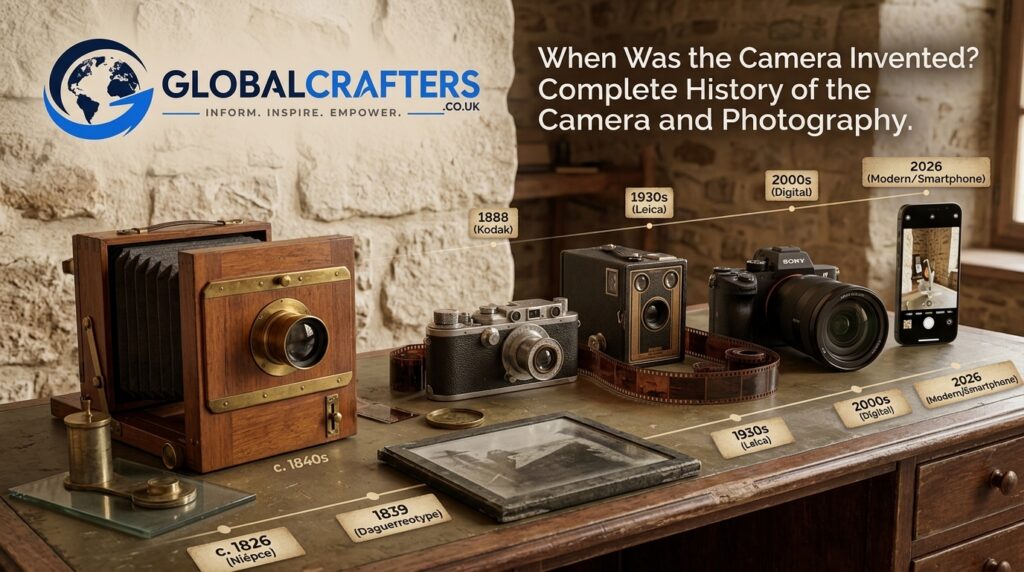
Camera Invention Timeline
The development of the camera happened over many centuries. Some of the most important milestones include:
Ancient and early optical principles: People observed that light passing through small openings could project images.
Camera obscura development: The optical device became increasingly sophisticated and was used by artists and scientists.
1720s: Johann Heinrich Schulze demonstrated that certain silver compounds were sensitive to light, contributing to the scientific foundations of photography.
Late 1700s and early 1800s: Inventors and scientists experimented with chemically recording images.
1826–1827: Joseph Nicéphore Niépce produced the earliest surviving permanent photograph made using a camera obscura.
1829: Niépce and Daguerre formed a partnership to improve photographic techniques.
1833: Niépce died, and Daguerre continued photographic experiments.
1839: The daguerreotype was publicly announced, helping photography become commercially practical.
1840s: Photographic technology continued improving, including negative to positive processes.
Late 1800s: Cameras became increasingly practical and portable.
1880s: George Eastman’s photographic innovations helped make photography much more accessible.
20th century: Film cameras became common for consumers, professionals, journalists, and filmmakers.
Late 20th century: Digital imaging technology began replacing traditional film photography.
21st century: Smartphones transformed cameras into everyday communication and content creation tools.
How Did the First Camera Work?
The earliest photographic cameras were very different from today’s smartphones and mirrorless cameras.
Niépce’s system essentially combined three important components:
- A camera obscura to project the scene.
- A light sensitive surface to receive the image.
- A chemical process to preserve the resulting image.
The camera itself did not need sophisticated electronics. Light entered through the optical opening and projected an image onto the prepared plate.
The problem was exposure time.
Modern cameras can capture an image in fractions of a second. Niépce’s early process required hours of exposure. This meant that moving objects could not easily be recorded.
Even sunlight changed position during the exposure, creating unusual lighting effects in the resulting photograph.
Despite these limitations, the technology demonstrated that photography was possible.
How Long Did the First Photograph Take?
One of the most surprising facts about early photography is how long it took to produce an image.
Niépce’s famous photograph required an exposure of several hours. Some historical sources describe an exposure of approximately eight hours.
Imagine trying to take a family photograph today and asking everyone to remain perfectly still for eight hours. It would obviously be impossible.
Early photography therefore had serious practical limitations.
Photographic inventors spent years trying to make photographic materials more sensitive and reduce exposure times. Daguerre’s work was particularly important because it produced a much more practical photographic process.
Over time, improvements in chemistry, lenses, shutters, film, and mechanical design dramatically reduced exposure times.
When Was the First Photograph of a Person Taken?
Photography initially struggled to capture moving people because early exposure times were extremely long.
One of the earliest known photographs containing a person was created by Daguerre in Paris in 1838. The long exposure meant that most moving pedestrians and vehicles were not recorded clearly. However, a man standing relatively still while having his shoes polished was captured in the scene.
This image became famous as an early photographic representation of a person.
The development illustrates how improvements in photographic technology gradually changed what cameras could record.
As exposure times became shorter, photographers could capture portraits, streets, animals, sports, and eventually fast moving events.
How Cameras Became Easier to Use
Early cameras were large, expensive, complicated, and difficult to operate.
Photography required knowledge of chemicals and exposure techniques. Photographers often had to prepare photographic materials themselves and carefully control the development process.
This limited photography largely to specialists.
During the 19th century, technological improvements gradually made cameras more convenient. Better lenses improved image quality, while improved photographic materials reduced exposure times.
The introduction of photographic film was another major turning point.
Instead of requiring photographers to prepare individual glass or metal plates for every photograph, flexible film allowed cameras to become more practical and portable.
This helped transform photography from a specialized scientific and artistic process into a popular consumer activity.
George Eastman and the Rise of Consumer Photography
The history of the camera cannot be discussed without mentioning George Eastman and Kodak.
Eastman’s innovations helped make photography easier for ordinary people. Flexible photographic film and relatively simple cameras allowed consumers to take photographs without needing to understand every chemical stage of photographic processing.
This represented a major change.
Photography was no longer limited to scientists, professional photographers, and wealthy enthusiasts. More families could begin documenting birthdays, holidays, weddings, vacations, children, and everyday life.
The camera became a household technology.
This transformation eventually created the foundation for the enormous global photography culture that exists today.
The Development of Film Cameras
For much of the 20th century, film cameras dominated photography.
Film cameras used photographic film coated with light sensitive chemicals. When light entered the camera, it interacted with the film and created a latent image. The film then had to be chemically processed to reveal the photograph.
Different film formats and camera designs were developed for different purposes.
Professional photographers used sophisticated cameras with interchangeable lenses and manual exposure controls. Consumers could use simpler point and shoot cameras.
Film photography also became central to the development of cinema.
Moving images are essentially a rapid sequence of individual frames. Cameras capable of recording many frames per second made motion pictures possible.
The Invention of the Digital Camera
The next major revolution in camera history was the development of digital imaging.
Instead of recording light on chemical film, digital cameras use electronic image sensors.
Two important sensor technologies are CCD and CMOS. These sensors convert incoming light into electronic information that can be processed and stored as a digital image.
Digital photography brought several advantages.
Photographers could review images immediately, store hundreds or thousands of photographs, transfer files electronically, and edit images using software.
This completely changed photography.
People no longer needed to wait for film to be developed before seeing whether a photograph was successful.
How the Smartphone Changed the Camera
The smartphone arguably created the biggest change in camera usage since the rise of consumer film photography.
Modern smartphones combine cameras, computers, image processing software, internet connectivity, and communication tools in one device.
A person can now capture an image, edit it, add text, send it to another person, and publish it online within seconds.
Smartphone cameras also use computational photography. Software can automatically adjust exposure, focus, colour, dynamic range, portrait effects, and low light performance.
This means that modern photography is no longer only about the physical camera lens and sensor.
Software has become an essential part of image creation.
Why Was the Camera Invented?
The development of the camera was driven by several different goals.
Artists wanted a more accurate way to reproduce visual scenes. Scientists wanted to understand and record optical phenomena. Inventors wanted to capture images permanently. Later, consumers wanted an easier way to preserve memories.
Photography eventually became useful for many industries.
Cameras are now used in:
- Journalism
- Film production
- Advertising
- Scientific research
- Medicine
- Security
- Astronomy
- Education
- Social media
- Sports
- Travel
- Wildlife research
- Real estate
- Manufacturing
- Space exploration
The camera has therefore become much more than a tool for taking family photographs.
Camera vs. Photography: Are They the Same Thing?
The terms “camera” and “photography” are closely related but do not mean exactly the same thing.
A camera is a device designed to capture an image.
Photography is the process and practice of creating images by recording light.
The camera obscura demonstrated how light could form an image, but it was not originally a photographic device because it did not permanently record the image.
Niépce’s work connected the optical camera with light sensitive chemistry.
Later inventors improved the process until cameras became practical photographic instruments.
This distinction explains why there is no single universally accepted date for the invention of the camera.
So, When Was the Camera Actually Invented?
The simplest answer is:
The camera evolved over centuries, but the first permanent photograph made using a camera is generally associated with Joseph Nicéphore Niépce around 1826–1827.
If you are asking about the camera obscura, its principles are much older.
If you are asking about the first successful permanent camera photograph, Niépce’s work in 1826–1827 is the key milestone.
If you are asking when practical photography became publicly available, 1839 is particularly important because Daguerre’s daguerreotype was publicly announced.
Therefore, it is more accurate to describe the invention of the camera as a long technological evolution rather than a single invention on a particular day.
You may also read more blogs
Frequently Asked Questions
When was the first camera invented?
The camera developed gradually from the camera obscura. The first permanent photograph made using a camera is generally credited to Joseph Nicéphore Niépce around 1826–1827.
Who invented the first camera?
Joseph Nicéphore Niépce is widely recognized as a pioneer of the first successful permanent camera photograph. However, the optical camera obscura has a much older history and cannot be attributed to one modern inventor.
What was the first photograph?
The earliest surviving photograph made using a camera is known as View from the Window at Le Gras, created by Joseph Nicéphore Niépce around 1826–1827.
How long did the first photograph take?
Niépce’s early photographic process required several hours of exposure, with historical sources commonly describing approximately eight hours for the famous early image.
When was photography invented?
Photography developed through multiple stages. Niépce produced an early permanent photograph around 1826–1827, while the daguerreotype was publicly announced in 1839 and helped establish practical photography.
Who invented the digital camera?
Digital camera development was a gradual process involving multiple engineers and companies rather than one simple inventor. Early electronic imaging experiments eventually led to practical digital cameras and today’s digital photography systems.
When did cameras become popular?
Cameras became increasingly popular during the late 19th and early 20th centuries as photographic film and simpler consumer cameras made photography more accessible.
Final Thoughts
The answer to “when was the camera invented?” depends on how we define a camera.
The basic optical principle behind the camera dates back centuries through the camera obscura. However, the breakthrough that transformed the camera into a genuine photographic device came in the 19th century.
Joseph Nicéphore Niépce’s experiments around 1826–1827 produced the earliest surviving permanent photograph made using a camera. His work demonstrated that light could permanently record a real world scene.
Louis Daguerre then helped make photography much more practical, with the daguerreotype being publicly announced in 1839.
From there, cameras continued evolving through film, consumer photography, instant cameras, digital sensors, DSLR systems, mirrorless cameras, and smartphones.
Today’s smartphone camera may seem completely different from Niépce’s wooden camera obscura, but the fundamental idea remains remarkably similar: light enters a camera, forms an image, and that image is recorded.
The camera’s journey from an ancient optical experiment to a device found in billions of pockets is one of the most fascinating stories in the history of technology.