
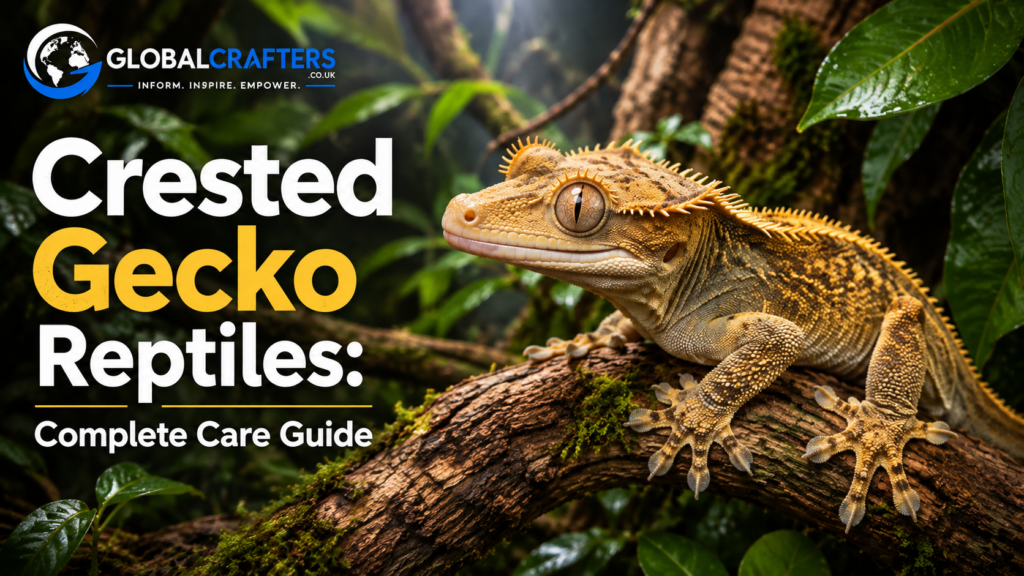

Crested gecko reptiles are among the most popular pet geckos because they combine an unusual appearance with manageable care requirements. Their scientific name is Correlophus ciliatus, and they are also commonly called eyelash geckos because of the distinctive crest like structures running above their eyes and along the sides of their head and body.
Native to New Caledonia, these small arboreal lizards spend much of their time climbing through vegetation rather than living on the ground. They are also known for their remarkable jumping ability and their ability to climb smooth surfaces.
For prospective owners, however, easy to keep does not mean needs little care. A healthy crested gecko requires the correct enclosure, temperature, humidity, nutrition, lighting, climbing opportunities, and routine monitoring.
What Are Crested Gecko Reptiles?
The crested gecko (Correlophus ciliatus) is a small arboreal reptile native to the islands of New Caledonia in the South Pacific. The species was first described scientifically in the nineteenth century and was later considered lost to science until populations were rediscovered in 1994.
Crested geckos have large eyes, soft looking skin, adhesive toe pads, and prominent crests around the head. Unlike many mammals and some other reptiles, they do not have movable eyelids. A transparent covering protects each eye, and the gecko uses its tongue to clean and moisten the eye surface.
Their arboreal body design is one of the most important things to understand before keeping one as a pet. They need vertical climbing opportunities rather than simply a large amount of floor space.
Natural Habitat and Behaviour
In their native New Caledonian environment, crested geckos live among vegetation, branches, trees, and other elevated surfaces. Their captive enclosure should therefore imitate a three dimensional forest environment rather than a flat terrestrial habitat.
They are generally most active during the evening and at night. During daylight hours, a pet crested gecko may spend considerable time resting among leaves, branches, cork, or other hiding areas.
This natural behaviour explains why a good enclosure should contain multiple climbing routes and areas of cover. Plants and branches are not merely decorative; they allow the animal to move, hide, explore, and choose between different microclimates.
Crested geckos are also excellent jumpers. Owners should open the enclosure carefully because an unexpected jump can allow a gecko to escape quickly.
Size, Lifespan, and Appearance
Adult crested geckos commonly reach around 5–8 inches in total length, with a substantial portion of that measurement coming from the tail. Under appropriate care, they can live approximately 15–20 years in captivity.
| Feature | Typical information |
|---|---|
| Scientific name | Correlophus ciliatus |
| Common names | Crested gecko, eyelash gecko |
| Adult length | About 5–8 inches |
| Typical lifespan | Around 15–20 years |
| Lifestyle | Arboreal |
| Diet | Omnivorous |
| Native region | New Caledonia |
| Activity | Mainly evening and night |
Their colour and pattern can vary considerably. Captive breeding has produced numerous colour and pattern varieties, but responsible breeding should prioritize health and sound structure rather than appearance alone.
Crested Gecko Temperament
A well adjusted crested gecko can become comfortable with gentle human interaction, although individual personalities differ. Some readily explore their keeper’s hands, while others remain more cautious.
Young geckos can be particularly jumpy. Instead of grabbing them from above, allow the animal to move onto your hand and support its body as it climbs.
Handling should be calm and controlled. A crested gecko that repeatedly attempts to leap away may be stressed or simply not ready for extended interaction.
Owners should also remember that geckos are not social animals in the same way as dogs or many birds. They do not require constant human attention to be content. A secure, enriched habitat and appropriate husbandry are more important than frequent handling.
Crested Gecko Enclosure Setup
Because crested geckos are arboreal, enclosure height is particularly important. PetMD recommends an enclosure of at least 20 gallons for a single adult, while experienced keepers often choose larger vertical habitats to provide greater opportunities for climbing and environmental enrichment.
A useful enclosure should include:
- Multiple sturdy branches
- Artificial or reptile safe live plants
- Cork bark or similar climbing surfaces
- Elevated resting locations
- Several hiding areas
- A secure, ventilated enclosure
- Food and water dishes
- Digital thermometers
- A hygrometer for humidity monitoring
Avoid creating an enclosure that is mostly empty space. A heavily furnished vertical habitat gives the gecko more opportunities to move naturally and select comfortable resting positions.
Substrate choice also matters. Fine sand, calcium sand, walnut shell, and some loose dusty materials can present risks if ingested. Veterinary guidance recommends avoiding inappropriate substrates that can contribute to irritation or gastrointestinal problems.
Temperature, Humidity, and Lighting
Temperature management is one of the most important parts of keeping crested gecko reptiles healthy. They can be particularly vulnerable to excessive heat, so owners should never assume that a warmer enclosure is automatically better.
PetMD recommends a warm area around 72–75°F (22–24°C), with a cooler area around 68–75°F (20–24°C), and warns against prolonged exposure above 80°F (27°C). Other husbandry sources use slightly different temperature targets, which demonstrates why monitoring actual enclosure conditions is more useful than relying on a single number.
Humidity should also fluctuate rather than remaining permanently saturated. The RSPCA recommends a normal humidity level around 40–50%, with temporary increases to approximately 80% through misting, while other veterinary guidance uses higher overall humidity targets. The key is to provide appropriate moisture while allowing the enclosure to dry sufficiently and maintaining good ventilation.
A hygrometer should be used instead of guessing humidity by appearance.
Lighting deserves attention as well. The RSPCA recommends providing a suitable low to medium UVB photogradient so the gecko can access UVB while also having shaded areas.
What Do Crested Geckos Eat?
Crested geckos are omnivores. Their diet can include fruit based foods and animal protein, but captive nutrition should not rely on random fruit or insects alone.
A nutritionally complete commercial crested gecko diet can form the foundation of feeding. Appropriately sized insects may also be offered as part of a varied diet, depending on the individual animal and the feeding plan.
Fresh drinking water should always be available.
Food intake should be monitored rather than assuming that an uneaten meal means the gecko is refusing food. Crested geckos may eat small quantities and can sometimes be difficult to observe while feeding because of their evening and nighttime activity.
If appetite changes significantly, the gecko loses weight, becomes unusually inactive, or develops other abnormal signs, a qualified exotic animal veterinarian should be consulted.
Handling and Daily Care
Daily care does not need to be complicated, but consistency matters.
A simple routine includes checking:
- Temperature readings
- Humidity readings
- Water availability
- Food condition
- Droppings
- General activity
- Skin and toes
- Overall body condition
- Enclosure cleanliness
Spot clean visible waste regularly and maintain the enclosure according to its substrate and design. Deeper cleaning should be performed as needed rather than allowing waste or spoiled food to accumulate.
When handling, keep the gecko close to a safe surface. Because these reptiles can jump suddenly, handling them over a bed, table, or another secure area is safer than handling them near an open doorway or high furniture.
Never pull a crested gecko by its tail. Like many geckos, it can drop its tail as a defensive response, and unlike some other geckos, a crested gecko generally does not regenerate a lost tail.
Common Health Concerns
Many health problems in captive reptiles are associated with incorrect husbandry, nutrition, temperature, humidity, or enclosure design.
Potential warning signs include:
- Persistent loss of appetite
- Noticeable weight loss
- Severe lethargy
- Abnormal movement
- Swollen or injured limbs
- Difficulty shedding
- Retained skin around toes
- Respiratory symptoms
- Persistent diarrhoea or abnormal droppings
- Weakness or difficulty climbing
One important preventive measure is maintaining appropriate calcium and vitamin nutrition while providing suitable environmental conditions. Poor nutrition and inadequate husbandry can contribute to serious skeletal and metabolic problems.
Owners should not attempt to diagnose significant illness from internet photographs alone. A reptile or exotic animal veterinarian is the appropriate professional when a gecko shows persistent or severe symptoms.
Are Crested Geckos Good Pets?
Crested geckos can be excellent pets for people who want a relatively quiet reptile that does not require a huge amount of daily interaction.
They are especially appealing because they are compact, visually distinctive, and interesting to observe. Their diet can also be simpler than that of some insect dependent reptile species when a nutritionally complete commercial diet is used appropriately.
However, prospective owners should consider the long commitment. A lifespan of 15–20 years means acquiring a crested gecko is not a short term responsibility.
They are a good choice for someone who is willing to monitor environmental conditions and maintain an appropriately furnished enclosure. They are less suitable for someone who wants a pet that enjoys frequent handling or requires little environmental management.
Final Thoughts
Crested gecko reptiles are fascinating arboreal lizards that can make rewarding pets when their natural needs are taken seriously. Their compact size and generally manageable care requirements make them attractive to beginners, but they still need a carefully controlled environment.
The most important priorities are a secure vertical enclosure, suitable climbing and hiding opportunities, safe temperature and humidity levels, appropriate lighting, balanced nutrition, clean water, and regular observation.
If you are considering getting a crested gecko, focus less on finding the most unusual colour morph and more on establishing excellent husbandry from day one. A healthy animal, appropriate enclosure, and informed keeper are the foundation of successful long term care.
You may also read more blogs
Frequently Asked Questions
Are crested geckos easy to care for?
Crested geckos are often considered beginner friendly reptiles, but they still need correct temperature, humidity, nutrition, lighting, enclosure design, and regular monitoring. “Beginner friendly” should not be confused with no maintenance.
How long do crested geckos live?
Crested geckos commonly have a captive lifespan of around 15–20 years when properly cared for. This makes them a long term commitment rather than a short lived starter pet
What size enclosure does a crested gecko need?
A single adult needs an appropriately sized vertical enclosure with sufficient height for climbing. PetMD lists 20 gallons or larger as a minimum for a single adult, while larger vertical habitats can provide additional enrichment.
Do crested geckos need heat?
They require appropriate environmental temperatures and a thermal gradient, but excessive heat can be dangerous. Their enclosure should be monitored with reliable thermometers rather than heated indiscriminately.
Do crested geckos need UVB?
UVB is recommended by animal welfare and husbandry guidance because it supports natural light cycles and vitamin D3 production. The important principle is to provide an appropriate gradient with shaded areas rather than exposing the animal continuously to intense UVB
Can crested geckos live together?
Keeping multiple crested geckos together can create territorial, breeding, and injury risks. In particular, two males should not be housed together. For most keepers, individual housing is the simplest way to control feeding and monitor health.
Can you handle a crested gecko?
Yes, many crested geckos can become accustomed to gentle handling. Allow the animal to climb onto your hand rather than grabbing it, and handle it close to a safe surface because these geckos can jump unexpectedly.
Why is my crested gecko not eating?
Reduced appetite can occur for several reasons, including stress, environmental problems, adjustment to a new enclosure, inappropriate temperatures, or illness. Check husbandry first, but persistent appetite loss or weight loss warrants veterinary assessment.