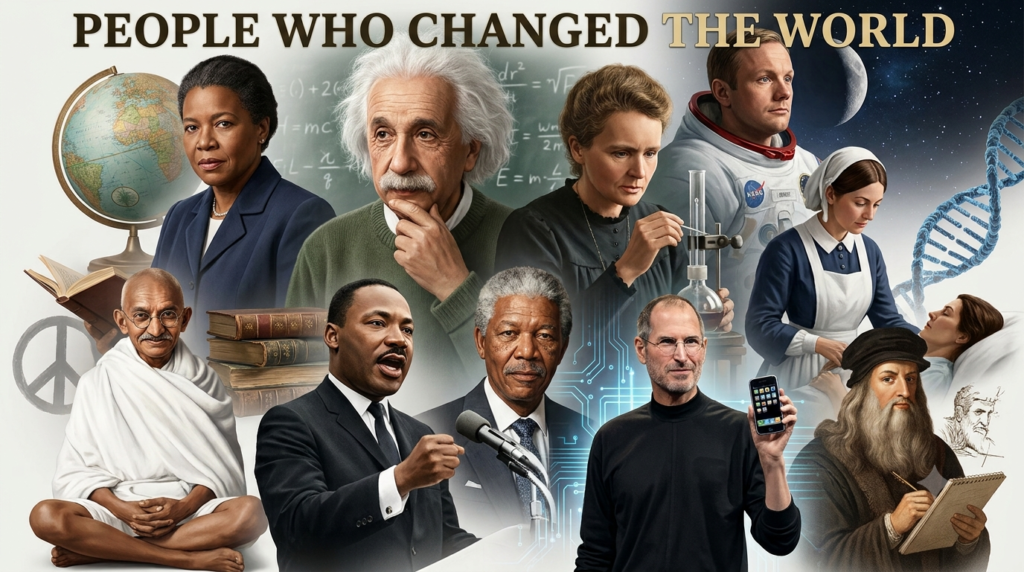

Throughout human history, certain individuals have had an extraordinary influence on the direction of civilization. Some changed the world through scientific discoveries, while others fought for equality, transformed political systems, created revolutionary technologies, or introduced ideas that changed how people understand themselves and the universe. The people who changed the world are not defined by a single profession or background. Their impact can be found across science, medicine, politics, education, technology, culture, and human rights.
Studying these influential people helps us understand how individual actions can create lasting change. The achievements of figures such as Albert Einstein, Marie Curie, Mahatma Gandhi, Martin Luther King Jr., Nelson Mandela, and Steve Jobs continue to influence millions of people. Some lived centuries ago, while others worked within living memory, yet their contributions remain relevant today.
This list is not intended to suggest that only famous individuals have shaped history. Millions of ordinary people have contributed to social progress, scientific research, community development, and cultural change. However, the figures discussed here represent some of the most recognizable examples of individuals whose ideas, discoveries, leadership, or courage had a significant global impact.
What Is a World Changing Person?
A world changing person is someone whose ideas, actions, discoveries, inventions, leadership, or activism significantly influence society beyond their own lifetime or local community. Their impact may affect millions or even billions of people, sometimes changing the way humanity lives, communicates, learns, works, or understands the world.
The phrase can describe scientists who expand human knowledge, activists who challenge injustice, leaders who reshape nations, inventors who create new technologies, or educators who introduce ideas that influence generations. In many cases, their influence is complex. Some historical figures made important contributions while also being associated with controversial decisions or beliefs, which is why studying their full historical context is important.
People Who Changed the World Through Science
Science has played one of the greatest roles in transforming human civilization. Scientific discoveries have changed our understanding of space, matter, evolution, energy, disease, and the natural world. Many scientists spent years investigating questions that eventually transformed entire fields of knowledge.
Among the most influential scientists in history are Albert Einstein, Marie Curie, Isaac Newton, and Charles Darwin. Their work continues to influence modern physics, chemistry, biology, medicine, and education.
Albert Einstein
Albert Einstein is one of the most recognizable scientists in history. His theory of relativity transformed modern physics and changed humanity’s understanding of space, time, gravity, and the relationship between matter and energy.
Einstein’s work extended far beyond academic science. His famous equation, E=mc², became one of the most recognized scientific equations in popular culture. His ideas contributed to developments in modern physics and continue to influence scientific research. His intellectual curiosity and ability to challenge established assumptions also made him a symbol of creative thinking.
Marie Curie
Marie Curie changed the world through pioneering research into radioactivity. Her scientific work contributed significantly to the understanding of radioactive elements and their properties.
Curie was also a groundbreaking figure for women in science. She became the first woman to win a Nobel Prize and remains the only person to receive Nobel Prizes in two different scientific fields. Her legacy can be seen in physics, chemistry, medical research, and the continued study of radiation.
Isaac Newton
Isaac Newton made foundational contributions to mathematics and physics. His work on motion and gravity helped establish principles that shaped classical mechanics for centuries.
Newton’s influence extended beyond physics. His contributions to mathematics, including the development of calculus alongside Gottfried Wilhelm Leibniz, had a profound effect on science and engineering. His work became an important foundation for understanding the physical world.
Charles Darwin
Charles Darwin transformed biological science through his theory of evolution by natural selection. His ideas changed how scientists understand the development and diversity of life on Earth.
Darwin’s work continues to be central to evolutionary biology. Although his theories generated significant debate when first introduced, the concept of evolution has become a fundamental part of modern biological science.
People Who Changed the World Through Human Rights and Social Change
Some of the most influential people in history are remembered not for scientific discoveries or inventions but for challenging injustice. Human rights leaders have often faced imprisonment, discrimination, violence, or social opposition while working toward greater equality.
Mahatma Gandhi, Martin Luther King Jr., Nelson Mandela, and Rosa Parks became important symbols of resistance and social transformation. Their stories demonstrate how peaceful protest, political activism, and personal courage can contribute to major changes in society.
Mahatma Gandhi
Mahatma Gandhi became internationally known for his philosophy of nonviolent resistance. He played a major role in India’s struggle for independence from British colonial rule and inspired movements for civil rights and freedom around the world.
Gandhi’s approach emphasized peaceful protest, civil disobedience, and moral resistance. His influence extended beyond India, with his ideas later inspiring activists and leaders in different parts of the world.
Martin Luther King Jr.
Martin Luther King Jr. was a central figure in the American Civil Rights Movement. He advocated for racial equality and challenged segregation through nonviolent activism.
King’s speeches and leadership helped draw international attention to the struggle for civil rights in the United States. His legacy continues to influence conversations about equality, justice, peaceful protest, and social responsibility.
Nelson Mandela
Nelson Mandela became one of the most respected figures in the global fight against racial oppression. He spent 27 years imprisoned under South Africa’s apartheid system before becoming the country’s first Black president.
Mandela became known internationally for his commitment to reconciliation and democracy. His life demonstrated the importance of perseverance, forgiveness, and political transformation, making him one of the most influential leaders of the modern era.
Rosa Parks
Rosa Parks became a major symbol of the American Civil Rights Movement after refusing to give up her seat to a white passenger on a segregated bus in Montgomery, Alabama.
Her arrest helped spark the Montgomery Bus Boycott, an important moment in the broader struggle against racial segregation. Parks’ story demonstrates how one act of resistance can become part of a much larger movement for social change.
People Who Changed the World Through Leadership and Politics
Political leaders have often influenced the lives of entire populations by shaping laws, institutions, and national policies. Some leaders guided their countries through wars or major political crises, while others helped establish new systems of government.
Political influence can be both positive and controversial, so historical figures should be evaluated within the context of their time. Their decisions often had complex consequences that continue to be debated by historians.
Abraham Lincoln
Abraham Lincoln is widely remembered for leading the United States during the Civil War. His presidency was closely connected to the struggle over slavery and the future of the Union.
Lincoln’s Emancipation Proclamation and his role in preserving the Union made him a central figure in American history. His leadership and speeches, including the Gettysburg Address, continue to be studied for their political and historical significance.
Winston Churchill
Winston Churchill is remembered primarily for his leadership of the United Kingdom during much of the Second World War. His speeches and public communication helped inspire resistance during a period of extraordinary national crisis.
Churchill’s historical legacy is complex and includes significant controversy surrounding his views and policies. Nevertheless, his role during World War II made him one of the most influential political figures of the twentieth century.
Queen Elizabeth II
Elizabeth II became the longest reigning British monarch and a globally recognized figure. Her reign covered major social, political, technological, and cultural changes.
Although the British monarch’s constitutional role is largely ceremonial, Elizabeth II represented continuity during decades of transformation. Her influence was especially visible in diplomacy, public life, and the symbolic role of the monarchy.
People Who Changed the World Through Technology
Technology has transformed nearly every aspect of modern life. From personal computers to the internet and smartphones, technological innovation has changed how people communicate, work, shop, study, and entertain themselves.
Some of the people associated with these changes became famous entrepreneurs, while others worked behind the scenes to develop systems that billions of people now use every day.
Steve Jobs
Steve Jobs played a major role in the development and popularization of consumer technology. As a co founder and later leader of Apple, he helped shape products that influenced personal computing, digital music, smartphones, and mobile applications.
Jobs was particularly known for emphasizing design and user experience. Products associated with his leadership helped make advanced technology more accessible and appealing to mainstream consumers.
Bill Gates
Bill Gates played a major role in the growth of personal computing through his work at Microsoft. The widespread use of Microsoft software helped make computers an essential part of homes, schools, and workplaces.
Gates later became prominent as a philanthropist. Through the Bill & Melinda Gates Foundation, his work has focused on global health, development, and other major social challenges.
Tim Berners-Lee
Tim Berners Lee changed the world by creating the World Wide Web. His work made it possible for information to be connected and accessed through websites and hyperlinks over the internet.
The web transformed communication, education, commerce, journalism, entertainment, and business. Today, billions of people rely on web based services every day, making Berners Lee one of the most important technological figures of the modern era.
Ada Lovelace
Ada Lovelace is often recognized as one of the earliest computer programmers. Her work on Charles Babbage’s proposed Analytical Engine included an algorithm that is widely regarded as an early example of computer programming.
Lovelace’s ideas were remarkable because they recognized that computing machines could potentially do more than perform numerical calculations. Her vision contributed to the broader history of computer science.
People Who Changed the World Through Medicine
Medical breakthroughs have dramatically increased human life expectancy and improved the treatment and prevention of disease. The work of medical researchers, nurses, doctors, and public health pioneers has saved countless lives.
Figures such as Alexander Fleming, Edward Jenner, and Florence Nightingale demonstrate how medical innovation and healthcare reform can have a lasting impact on humanity.
Alexander Fleming
Alexander Fleming is famous for discovering penicillin, an important antibiotic that transformed modern medicine. Antibiotics have played a crucial role in treating bacterial infections and reducing deaths from diseases that were once frequently fatal.
Fleming’s discovery became one of the most important medical breakthroughs of the twentieth century. The development and widespread use of antibiotics fundamentally changed healthcare.
Edward Jenner
Edward Jenner is widely associated with the development of the first successful smallpox vaccine. His work helped establish the principle of vaccination as a powerful method for preventing infectious disease.
The legacy of vaccination has expanded enormously since Jenner’s time. Modern immunization programs have helped control and eliminate serious diseases in many parts of the world.
Florence Nightingale
Florence Nightingale transformed professional nursing and hospital practices. She emphasized sanitation, organization, patient care, and the use of statistics to improve healthcare.
Nightingale’s work helped establish nursing as a respected profession and influenced hospital management and public health. Her legacy continues through modern nursing education and healthcare systems.
People Who Changed the World Through Education and Ideas
Not every person who changed the world invented something physical. Philosophers, teachers, writers, and thinkers have influenced civilization by changing how people understand morality, knowledge, society, and human behavior.
The ideas of Confucius, Socrates, and Leonardo da Vinci demonstrate the enormous influence that intellectual curiosity and education can have across generations.
Confucius
Confucius was an influential Chinese philosopher whose teachings shaped social and educational thought across East Asia for centuries.
His philosophy emphasized education, ethical behavior, respect for family, social responsibility, and good governance. His influence continues to be visible in philosophical and cultural traditions around the world.
Socrates
Socrates is considered one of the foundational figures of Western philosophy. Although he left no writings of his own, his ideas and method of questioning were recorded by students and later philosophers.
The Socratic method, which uses questions to examine assumptions and ideas, remains influential in education and critical thinking. His legacy demonstrates the power of asking difficult questions rather than simply accepting conventional wisdom.
Leonardo da Vinci
Leonardo da Vinci represented the extraordinary curiosity of the Renaissance. He was an artist, inventor, engineer, anatomist, and scientist whose notebooks reveal a remarkable range of interests.
His paintings, including the Mona Lisa and The Last Supper, became cultural landmarks, while his scientific observations and mechanical designs demonstrated an unusually broad approach to learning. Da Vinci remains a symbol of creativity and interdisciplinary thinking.
People Who Changed the World Through Exploration and Discovery
Exploration has expanded humanity’s understanding of geography, space, and the natural world. Explorers and astronauts have ventured into unknown environments, creating new knowledge and inspiring generations.
However, exploration should also be examined critically because historical exploration was sometimes connected to colonialism, exploitation, and conflict. Understanding both achievements and consequences provides a more complete view of history.
Christopher Columbus
Christopher Columbus is one of history’s most discussed explorers. His voyages across the Atlantic in the late fifteenth century connected Europe and the Americas in ways that profoundly changed global history.
His legacy is highly complex. The encounters that followed contributed to extensive exchange of crops, animals, and ideas, but also to colonization, violence, exploitation, and devastating consequences for Indigenous populations. His story is therefore important to study from multiple historical perspectives.
Neil Armstrong
Neil Armstrong became the first person to walk on the Moon during NASA’s Apollo 11 mission in 1969. The achievement represented a major milestone in space exploration and scientific history.
Armstrong’s historic achievement inspired generations to pursue science, engineering, and space exploration. The Apollo program also demonstrated the possibilities of large scale scientific and technological cooperation.
Why Are These People Still Remembered?
The people who changed the world continue to be remembered because their influence extends beyond their own lifetimes. Their discoveries, ideas, inventions, and struggles created changes that shaped institutions and societies for generations.
Some are remembered through schools and universities, while others appear in museums, books, documentaries, public monuments, and popular culture. Their lives provide examples of creativity, determination, leadership, courage, and intellectual curiosity.
At the same time, history is rarely simple. A person can make an important contribution while also having serious flaws or participating in harmful systems. Studying historical figures critically allows us to appreciate their achievements without ignoring the wider consequences of their actions.
How World Changing People Influence Our Lives Today
The influence of these individuals can be found in everyday life. When someone uses a smartphone, accesses a website, receives medical treatment, studies science, participates in a democratic society, or advocates for equal rights, they may be benefiting from ideas developed through generations of innovation and social change.
The most important lesson is that world changing impact does not always happen immediately. Many groundbreaking ideas were initially rejected or misunderstood. Over time, however, they influenced other people who continued developing them.
This suggests that changing the world is not limited to famous celebrities, scientists, or political leaders. Teachers, entrepreneurs, researchers, activists, engineers, artists, and community leaders can all contribute to meaningful progress. The future’s most influential people may be individuals whose work is still unknown today.
Conclusion
The story of the people who changed the world is ultimately a story about human potential. From scientists who expanded our understanding of the universe to activists who challenged injustice, these individuals demonstrate that ideas and actions can have consequences far beyond a single lifetime. Albert Einstein, Marie Curie, Isaac Newton, Mahatma Gandhi, Martin Luther King Jr., Nelson Mandela, Steve Jobs, Tim Berners Lee, Alexander Fleming, and many others each contributed to different aspects of human progress. Their paths were not identical, and their legacies are sometimes complex, but their influence remains part of the world we live in today.
Frequently Asked Questions
Who are the most famous people who changed the world?
Some of the most widely recognized world changing figures include Albert Einstein, Marie Curie, Mahatma Gandhi, Martin Luther King Jr., Nelson Mandela, Isaac Newton, Leonardo da Vinci, Steve Jobs, Tim Berners Lee, and Alexander Fleming. Their contributions span science, human rights, technology, medicine, philosophy, and culture.
Who changed the world the most?
There is no universally agreed answer to who changed the world the most. Different people have had different types of influence, and comparing them directly can be difficult..
Who is the most influential person in history?
The most influential person in history is a matter of debate. Historians and researchers may consider religious leaders, philosophers, scientists, political leaders, inventors, and social reformers depending on their area of study.
Who changed the world through science?
Many scientists changed the world through major discoveries and theories. Albert Einstein transformed physics, Marie Curie advanced research into radioactivity, Isaac Newton established foundational principles of classical mechanics, and Charles Darwin transformed biological thought through evolution by natural selection.
Who changed the world through human rights?
Mahatma Gandhi, Martin Luther King Jr., Nelson Mandela, and Rosa Parks are among the best known figures associated with major human rights and civil rights movements.
Why do people study famous people who changed history?
Studying influential historical figures helps people understand how societies develop and how major changes happen. Their experiences can teach lessons about leadership, innovation, courage, failure, responsibility, and perseverance.
Can an ordinary person change the world?
Yes. Major social and technological changes often begin with individuals who identify problems and take action. A person does not need to be famous to create meaningful change..
Who could be considered a modern person changing the world?
Modern world changing figures can be found in technology, medicine, climate science, education, entrepreneurship, and social activism. However, identifying the most influential living people is subjective and changes over time.
You may also read more blogs
Most Popular Superheroes