
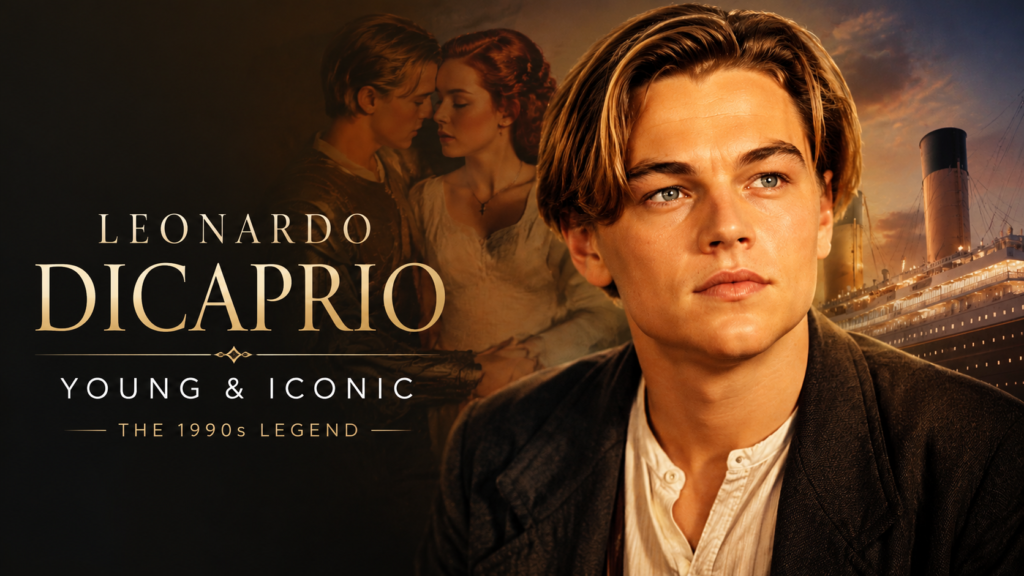

The phrase Leonardo DiCaprio young brings back one of the most recognizable eras in modern Hollywood. Long before he became an Academy Award winning actor associated with demanding directors and complex adult characters, DiCaprio was a fresh faced performer with expressive blue eyes, a distinctive curtain haircut, and an unusually intense acting style.
His 1990s image is often remembered through romantic scenes from Titanic and Romeo + Juliet. However, his early career was far more varied than those two films suggest. As a teenager, he portrayed neglected children, troubled students, poets, rebellious sons, and characters facing physical or emotional hardship. His willingness to choose difficult roles helped separate him from other young celebrities of the period.
DiCaprio’s journey from television commercials to international stardom was not an overnight success. It developed through years of auditions, supporting appearances and critically demanding performances. By the time Titanic arrived in 1997, he had already received an Academy Award nomination and earned recognition as one of the most promising actors of his generation.
Who Is Young Leonardo DiCaprio?
Young Leonardo DiCaprio refers to the actor during his childhood, teenage years and early twenties, particularly from the late 1980s through the end of the 1990s. During this period, he moved from commercials and television into serious films before becoming an international celebrity.
Leonardo Wilhelm DiCaprio was born on November 11, 1974, in Los Angeles, California. He began pursuing entertainment work at a young age and appeared in commercials before finding opportunities on television. His early years in front of the camera allowed him to develop confidence, timing and an ability to communicate strong emotion without relying entirely on dialogue.
Although his youthful appearance later helped him become a romantic idol, DiCaprio’s strongest early performances depended on emotional realism rather than conventional glamour. In films such as This Boy’s Life and What’s Eating Gilbert Grape, he played vulnerable young men whose lives were shaped by difficult family circumstances.
That contrast became central to his early appeal. Audiences saw a handsome rising star, while filmmakers recognized a performer capable of fear, instability, humor and emotional pain. His career therefore developed along two paths: teenage celebrity and respected dramatic actor.
What Is the Young Leonardo DiCaprio Era?
The young Leonardo DiCaprio era is generally associated with his work from the beginning of the 1990s through films such as The Man in the Iron Mask and The Beach. It includes his transition from child performer to television actor, independent film discovery, teenage heartthrob and major Hollywood leading man.
The period is remembered visually for his center parted blond or light brown hair, relaxed clothing, youthful facial features and red carpet appearances. Yet it is also an important stage in his artistic development. Many of the qualities visible in his later work restless energy, psychological intensity and complete commitment to a character were already present in his teenage performances.
His early filmography also shows that he did not follow a single commercial formula. After gaining attention, he moved between a family drama, a Western, a disturbing biographical film, a Shakespeare adaptation and a large scale historical romance.
This variety helped him avoid being defined exclusively as a child actor. Even when his popularity grew dramatically, he continued choosing characters who were emotionally damaged, socially isolated or placed under extreme pressure.
Leonardo DiCaprio’s Early Life and Childhood
DiCaprio grew up in Los Angeles and was raised mainly by his mother after his parents separated. His father remained involved in his life, and both parents encouraged his creative interests. The neighborhoods surrounding him exposed him to very different sides of Los Angeles, including artistic communities and economically difficult urban areas.
As a child, he enjoyed performing impressions and entertaining people. He considered different ambitions, including becoming a marine biologist, but acting eventually became his main pursuit. He attended schools in Los Angeles before focusing more seriously on auditions and entertainment work.
His early experience did not resemble the carefully managed launch of a studio created celebrity. He faced rejection and reportedly struggled to find professional representation that believed his name would be marketable. Instead of adopting a stage name permanently, he continued using Leonardo DiCaprio.
That persistence later became a defining feature of his career. He was willing to move through small jobs, commercials and minor television appearances while waiting for parts that could demonstrate more than his appearance.
How Leonardo DiCaprio Started Acting
Commercials and Early Television Appearances
DiCaprio began appearing in commercials when he was still young. Advertisements gave him practical experience with cameras, production crews, repeated takes and the discipline required to deliver a performance within a limited amount of time.
He later secured small television roles, including appearances on programs such as The New Lassie, Santa Barbara and Parenthood. These jobs were not yet major breakthroughs, but they gave casting professionals an opportunity to see his confidence and natural energy on screen.
Television also taught him how to work within established casts. Unlike a commercial, a television role required him to develop a character across scenes and respond naturally to other actors.
His youthful spontaneity could occasionally appear unpredictable, but that same quality made his performances feel alive. Rather than delivering lines mechanically, he reacted with facial expressions and physical movements that attracted attention.
Critters and Growing Pains
DiCaprio made his feature film debut in the low budget horror sequel Critters 3, released in 1991. The role was not an artistic showcase, and he later treated the film as a modest beginning rather than an important achievement.
Its significance lies in the experience it provided. Appearing in a feature film helped him create a professional record and move closer to more substantial opportunities. It also demonstrated that early career projects do not always predict the direction of an actor’s future work.
He then joined the television sitcom Growing Pains as Luke Brower, a homeless teenager taken in by the Seaver family. The role introduced him to a larger television audience and positioned him as an appealing young performer near the end of the series’ run.
Although Growing Pains did not make him a film star, it increased his visibility. More importantly, it gave him enough industry momentum to audition for projects that required greater dramatic depth.
Leonardo DiCaprio’s Dramatic Breakthrough
This Boy’s Life
DiCaprio’s performance in This Boy’s Life marked an important change in how the industry viewed him. Released in 1993, the film starred him as Toby Wolff, a rebellious teenager living under the control of an abusive stepfather played by Robert De Niro.
Working opposite De Niro required DiCaprio to project confidence while portraying fear, resentment and emotional confusion. The conflict between the two characters gave the young actor an opportunity to display a level of intensity rarely expected from performers of his age.
The film also proved that DiCaprio could carry emotionally difficult material. Toby was not written as a simple victim or idealized teenager. He could be dishonest, impulsive and angry, yet he remained understandable because DiCaprio captured his need for freedom and approval.
The performance became one of the first clear indications that he could develop into a serious leading actor. Retrospective coverage has described This Boy’s Life and What’s Eating Gilbert Grape as the two 1993 films that firmly established his potential.
What’s Eating Gilbert Grape
Later in 1993, DiCaprio appeared as Arnie Grape, the developmentally disabled younger brother of Johnny Depp’s character, in What’s Eating Gilbert Grape. The role demanded precise physical behavior, vocal control and emotional sensitivity.
DiCaprio reportedly prepared by observing young people living with developmental disabilities. Instead of presenting Arnie as a collection of exaggerated mannerisms, he created a character who was playful, frustrating, affectionate and emotionally connected to his family.
Critics quickly recognized the performance. Roger Ebert wrote that DiCaprio deserved his Academy Award nomination, while other reviews identified him as one of the film’s most memorable elements. His work was especially striking because many viewers were unfamiliar with him and initially did not realize how carefully constructed the performance was.
DiCaprio received his first Oscar nomination for Best Supporting Actor. He was only 19 during that awards season, making the achievement an extraordinary early career milestone. The nomination established that he was not simply a promising television performer but an actor already capable of competing at the industry’s highest level.
From Serious Actor to Nineties Icon
The Basketball Diaries and Total Eclipse
In The Basketball Diaries, DiCaprio played Jim Carroll, a talented high-school basketball player whose life deteriorates through drug addiction. The film required him to move from youthful confidence to desperation, physical decline and emotional instability.
The performance was raw and sometimes deliberately uncomfortable. It strengthened his reputation for choosing young characters who were in crisis rather than accepting only safe or flattering roles.
During the same period, DiCaprio portrayed French poet Arthur Rimbaud in Total Eclipse. The film explored Rimbaud’s artistic rebellion and turbulent relationship with fellow poet Paul Verlaine.
Neither film achieved the enormous mainstream reach of his later work, but both contributed to his development. They allowed him to explore addiction, sexuality, creativity and self destruction before Hollywood began presenting him primarily as a romantic leading man.
Romeo and Juliet
Baz Luhrmann’s Romeo + Juliet gave DiCaprio one of his defining young roles. Released in 1996, the film placed Shakespeare’s original dialogue inside a modern world of guns, television reports, customized cars and urban conflict.
DiCaprio played Romeo opposite Claire Danes as Juliet. His interpretation combined romantic sensitivity with impulsive teenage emotion, making Shakespeare’s character understandable to viewers who might otherwise have considered the play distant or overly formal.
The film’s visual style also transformed DiCaprio into an international romantic icon. His beach scenes, emotional close ups and youthful appearance became central to the movie’s marketing and long term cultural memory.
However, the performance worked because he treated the language seriously. He communicated meaning through rhythm, expression and physical reaction, helping a new generation connect with the tragedy rather than simply admire the film’s fashionable design.
How Titanic Changed Leonardo DiCaprio’s Life
Before Titanic, Leonardo DiCaprio was already respected and increasingly popular. After Titanic, he became one of the most famous actors in the world. James Cameron’s film cast him as Jack Dawson, a poor, adventurous artist who wins passage aboard the ship and falls in love with Rose DeWitt Bukater, played by Kate Winslet.
Principal photography began in 1996, when DiCaprio was 21. He turned 22 during the production and was 23 when the movie received its major United States release in December 1997. Because Jack is presented as youthful, free spirited and emotionally fearless, viewers often remember DiCaprio as being even younger.
Jack Dawson became a defining romantic character of 1990s cinema. DiCaprio gave him optimism and humor, but he also made the performance emotionally direct. Jack’s lack of wealth is balanced by his curiosity, artistic talent and willingness to experience life without social restrictions.
The relationship between Jack and Rose helped make the disaster emotionally personal. Instead of experiencing the sinking only as a historical event, viewers followed it through two young people whose future appeared possible until the ship’s collision changed everything.
The film became a worldwide phenomenon, earned 14 Academy Award nominations and won 11, including Best Picture. The Academy has described it as the film that catapulted DiCaprio and Winslet to global stardom.
The resulting wave of attention was often called Leo mania. Posters, magazines, interviews and fan communities turned him into one of the decade’s biggest celebrity figures. That fame gave him immense career power, but it also created a challenge: he needed to prove that he could outgrow the heartthrob image.
What Made Young Leonardo DiCaprio Stand Out?
Young Leonardo DiCaprio possessed an unusual combination of accessibility and intensity. He could appear playful and charming in one scene, then anxious or emotionally volatile in the next. His characters frequently seemed to be thinking faster than they could speak.
His face was highly expressive, allowing filmmakers to use close ups effectively. Small changes in his eyes, jaw or posture could communicate embarrassment, anger, fear or attraction without explanatory dialogue.
He also brought physical energy to his roles. In early films, he rarely appeared completely still. He climbed, ran, argued, laughed nervously or shifted his body as though his characters could not comfortably contain their emotions.
That restlessness became especially effective in films about trapped young men. Whether the restriction came from an abusive family, addiction, poverty or social expectation, DiCaprio made the desire to escape feel immediate.
His role selection was equally important. Rather than protecting a perfect celebrity image, he repeatedly portrayed flawed or vulnerable people. That willingness created credibility before Titanic made him a global idol.
Young Leonardo DiCaprio’s Hair and Fashion
The most recognizable young Leonardo DiCaprio hairstyle was the 1990s curtain cut. His hair was generally parted near the center, with longer sections falling toward both sides of his forehead.
The style appeared in different forms throughout the decade. It could look polished during premieres, windblown in editorial photographs or soft and romantic in movies. Because of DiCaprio’s enormous popularity, the haircut became one of the most widely remembered men’s styles of the period.
His fashion was usually less complicated than his hair. Off screen photographs frequently showed him in plain T shirts, leather jackets, relaxed shirts, denim and simple suits.
That understated wardrobe contributed to his appeal. He looked recognizably like a young man of the 1990s rather than a celebrity dressed in an overly manufactured costume. Today, recreations of his style often combine a middle part haircut, loose jacket, white shirt and minimal accessories.
Reviews of Leonardo DiCaprio’s Early Performances
Critical reviews of DiCaprio’s early career often focused on his emotional naturalism. His performance in What’s Eating Gilbert Grape received particular praise because he disappeared into the character despite having features that would soon make him a major heartthrob.
Roger Ebert supported his Oscar nomination, and contemporary reviews repeatedly identified DiCaprio as a standout within an already strong cast. The performance remains one of the most frequently recommended starting points for viewers who know him mainly from later blockbusters.
Retrospective reviews also highlight the range visible in his 1993 work. This Boy’s Life depended on anger and defiance, while What’s Eating Gilbert Grape required careful observation and warmth.
His later 1990s films proved that serious acting ability could coexist with mainstream appeal. Romeo + Juliet demonstrated romantic charisma, while Titanic showed he could anchor a massive production without losing the personal qualities that first made audiences notice him.
Why Is Young Leonardo DiCaprio Trending?
Young Leonardo DiCaprio remains popular because 1990s culture continues to attract new audiences. Fashion, hairstyles, film photography and celebrity interviews from that decade circulate widely across social platforms.
His early photographs are especially shareable because they capture a recognizable but very different stage of his life. Recent entertainment coverage has continued publishing vintage photographs and retrospectives about his transformation from teenage actor to established Hollywood figure.
Streaming and digital rentals have also allowed younger viewers to discover films released before they were born. Someone who first encounters DiCaprio in Inception, The Wolf of Wall Street or The Revenant may later search for his early performances.
The interest is not based only on appearance. Viewers are often surprised by how developed his acting was before Titanic. That discovery encourages searches for young Leonardo DiCaprio movies, interviews, photographs, hairstyles and age related facts.
Latest Update on Leonardo DiCaprio
Leonardo DiCaprio continues to work selectively with major filmmakers. His 2025 release One Battle After Another, directed by Paul Thomas Anderson, placed him alongside a cast that included Sean Penn, Benicio del Toro, Regina Hall, Teyana Taylor and Chase Infiniti. Warner Bros. released the film theatrically in September 2025.
His performance received an Academy Award nomination for Best Actor at the 2026 ceremony. Although Michael B. Jordan won the category, the nomination added another major recognition to DiCaprio’s long awards history.
The nomination demonstrated the lasting value of the skills visible in his youth. The emotional commitment that first attracted critics in What’s Eating Gilbert Grape remains part of his screen identity decades later.
At the same time, interest in his younger years has not faded. Each new film encourages viewers to compare the mature performer with the ambitious teenager who worked alongside Robert De Niro and earned an Oscar nomination before becoming a global star.
Conclusion
The story of Leonardo DiCaprio young is much more than a collection of nostalgic photographs. His younger years reveal how persistence, intelligent role selection and emotional courage allowed a child performer to become one of the defining actors of his generation. Before Titanic made him an international heartthrob, DiCaprio had already challenged himself with difficult characters in This Boy’s Life, What’s Eating Gilbert Grape, The Basketball Diaries and Total Eclipse. Those performances gave his later fame a strong artistic foundation.
Frequently Asked Questions About Young Leonardo DiCaprio
The following answers address the most common questions people ask about Leonardo DiCaprio’s childhood, age, early films and rise to fame. Because filming and release dates are different, an actor’s age during production may not always match the age reported when a movie entered cinemas.
How old was Leonardo DiCaprio in Titanic?
DiCaprio was 21 when principal photography began in 1996 and turned 22 during the production. He was 23 by the movie’s major United States release in December 1997. He played Jack Dawson as a youthful traveler with no permanent home or social position. His appearance and energetic performance caused many viewers to assume he was closer to Jack’s implied age.
How old was Leonardo DiCaprio in Romeo and Juliet?
DiCaprio was approximately 21 during the period surrounding the production and release of Baz Luhrmann’s Romeo + Juliet. The movie reached theaters in 1996.His youthful face and emotional acting made him convincing as Shakespeare’s impulsive young lover, even though the original Romeo is generally understood to be younger.
What was Leonardo DiCaprio’s first movie?
His first feature film appearance was in Critters 3, a low budget horror sequel released in 1991. He played Josh, the stepson of a building manager.The film was not a major critical breakthrough, but it helped him gain screen experience and move toward stronger television and film opportunities.
Was Leonardo DiCaprio a child actor?
Yes. DiCaprio began working in commercials and television while he was young. His early credits included advertisements and small parts in television programs.He became more widely recognizable through Growing Pains before establishing himself as a dramatic film actor in the early 1990s.
What movie made Leonardo DiCaprio famous?
What’s Eating Gilbert Grape made critics and awards voters take him seriously, while Romeo + Juliet greatly expanded his popularity. However, Titanic made him a worldwide household name. Its commercial and cultural impact transformed him from a rising Hollywood star into an international celebrity.
Did young Leonardo DiCaprio win an Oscar?
DiCaprio did not win an Oscar during his younger years, but he received his first nomination for What’s Eating Gilbert Grape when he was 19.He eventually won Best Actor for The Revenant at the 88th Academy Awards in 2016.
What are the best young Leonardo DiCaprio movies?
The strongest early selections include This Boy’s Life, What’s Eating Gilbert Grape, The Basketball Diaries, Romeo + Juliet and Titanic. These films show different sides of his talent. Viewers can see him move from intimate family drama and psychologically difficult material to romance and large-scale Hollywood spectacle.
What was Leonardo DiCaprio’s young hairstyle called?
His best-known youthful hairstyle is commonly called a curtain haircut or middle-part hairstyle. Longer front sections fall toward both sides of the face. The haircut became closely associated with 1990s men’s fashion and remains a common reference for people recreating vintage celebrity styles.
You may also read more blogs